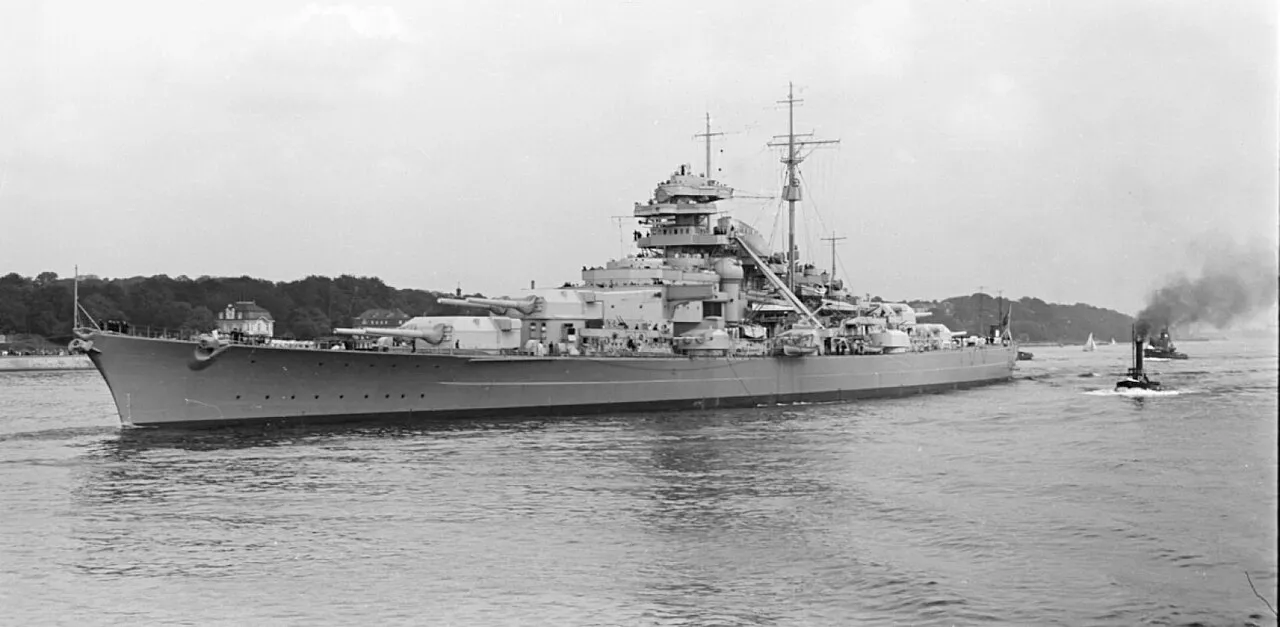
Bismarck was the first of two Bismarck-class battleships built for Nazi Germany’s Kriegsmarine, named after Chancellor Otto von Bismarck. She and her sister ship Tirpitz were the largest warships of their type to be constructed in Europe2. She conducted only one offensive operation1: in May 1941 she and the heavy cruiser Prinz Eugen left the Baltic to attack British convoys in the Atlantic. On 24 May, west of Iceland, the battlecruiser Hood blew up after a direct hit from Bismarck, and on 27 May British battleships and heavy cruisers sank her within two hours3.
Design and construction
The two ships of the class were designed in the mid-1930s as a counter to French naval expansion1, specifically the two Richelieu-class battleships France had started in 1935. Garzke and Dulin, writing for the International Naval Research Organization, call it a very conservative design2 based on the World War I battleships Baden and Bayern, but with heavier protection, better grades of armor steel and more speed.
The 1935 Anglo-German Naval Treaty obliged Germany to observe the naval treaties signed in 1922 and 1930. When the final design was found to exceed the 35,000-ton standard displacement limit of the 1936 London Treaty, it was decided to proceed with a ship of 42,000 tons standard displacement2 and to try to deceive the British and Americans about her size. The Royal Museums Greenwich likewise notes that Bismarck and Tirpitz were nominally built to the 35,000-ton limit3 but were much larger, and so better protected than most foreign ships.
Blohm & Voss in Hamburg laid her keel on 1 July 1936. She was launched on 14 February 1939 and christened by Dorothee von Löwenfeld, granddaughter of the ship’s namesake, and the original straight stem was replaced with a raked “Atlantic bow” during fitting-out. She was commissioned on 24 August 19401 under Kapitän zur See Ernst Lindemann.
Specifications
The Royal Museums Greenwich gives a displacement of 41,700 tons3, a length of 823 feet and a beam of 118 feet. NavWeaps lists a waterline length of 792.48 feet (241.5 m)2 and a waterline beam of 36 m.
She was powered by three Blohm & Voss geared steam turbines driving three propellers, with steam from twelve oil-fired Wagner boilers. The plant was rated for 29 knots, but on trials she reached 30.01 knots1. NavWeaps gives an endurance of 9,500 nautical miles at 19 knots. The three-shaft layout gave her a large beam and a GM of 13.41 feet; Garzke and Dulin write that her GM exceeded the “good design practice” standard in many respects, and they call her a lively gun platform2.
Her main battery was eight 38 cm guns in four twin turrets, backed by twelve 15 cm guns, sixteen 10.5 cm anti-aircraft guns and lighter 3.7 cm and 2 cm anti-aircraft guns. The main armor belt was 320 mm thick, and the main turret face plates 360 mm. She carried four Arado-196 floatplanes2. The standard crew numbered 103 officers and 1,962 enlisted men1.
Service history
Bismarck spent the early months of 1941 undertaking sea trials3. Garzke and Dulin write that the German naval high command had planned a three-month raid into the North Atlantic for April, with the battlecruisers Gneisenau and Scharnhorst, but both had to be withdrawn. Bismarck and Prinz Eugen sortied separately from Gotenhafen on 18 May 19412 and, after a stop near Bergen, steamed into the Norwegian Sea.
On 23 May the British heavy cruisers Norfolk and Suffolk spotted the German ships in the Denmark Strait. In the battle the next morning, at least one of Bismarck’s shells reached Hood’s rear ammunition magazine1, and Hood sank with all but three of her crew of 1,419. Prince of Wales was damaged, and Bismarck was struck, damaging one of her fuel tanks. A 14-inch shell flooded two bow compartments, depriving her of more than 1,000 tons of fuel oil2. After separating from Prinz Eugen, she headed for France to refuel and carry out repairs3.
At dusk on 24 May, Swordfish torpedo bombers from Victorious made only one hit, on the 320-mm main armor belt. Swordfish from Ark Royal then hit her3 as well; according to Garzke and Dulin, fifteen planes took part and two torpedo hits were made. The second torpedo hit the steering area, and the rudders were jammed at 12 degrees to port2.
Fate
On the morning of 27 May 1941 she was surrounded by British forces including the battleships King George V and Rodney, the heavy cruisers Norfolk and Dorsetshire and nine destroyers. The battle began at 0847, with the British firing first. By 09:31 all four main battery turrets had been put out of action. The executive officer, Commander Hans Oels, ordered the scuttling of the ship between 0920 and 09302. Dorsetshire torpedoed her, and Bismarck disappeared beneath the surface at 10:40. Out of a crew of over 2,200 men, only 114 survived1.
Robert Ballard found the wreck on 8 June 1989, resting on her keel at a depth of approximately 4,791 m, about 650 km west of Brest. Ballard found no evidence of the internal implosions1 that occur when a hull that is not fully flooded sinks. Garzke and Dulin describe a piece of port-side plating seen in the debris field that year as clear evidence of structural failure in the welded joint2 at the stern.
Sister ships and similar ships
Bismarck’s sister ship was Tirpitz; Garzke and Dulin write that the stern design deficiency was later recognized in Tirpitz, whose longitudinal bulkheads were extended into the stern during repairs in Norway. The Royal Navy was building five King George V-class battleships armed with ten 14-inch/45 guns, and they were acknowledged as being incapable of defeating either Bismarck or Tirpitz2 in single combat. The two French Richelieu-class battleships started in 19351 were what the Bismarck class was designed to counter.