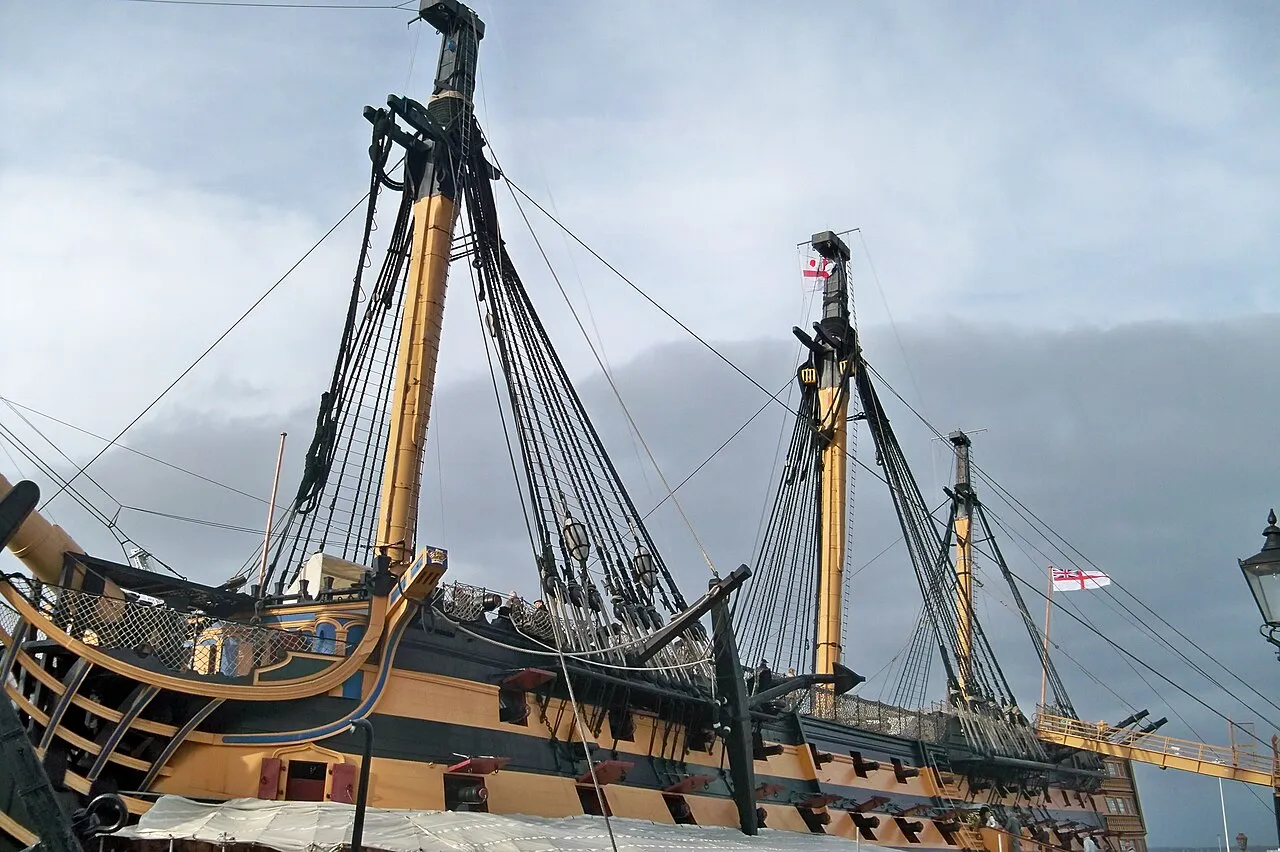
HMS Victory is a 104-gun first-rate wooden sailing ship of the line of the Royal Navy. She is best known as Lord Nelson’s flagship at the Battle of Trafalgar on 21 October 1805. Nelson served in her for just over two years until his death in that battle, but the ship had by then been in active service for more than 20 years2. The National Museum of the Royal Navy calls her the oldest commissioned warship in the world. She was placed into dry dock in 19223 at Portsmouth, where she is now maintained as a museum ship1.
Design and construction
In December 1758 Prime Minister William Pitt the Elder requested the building of 12 ships, and Chatham Dockyard was ordered to start work on a first-rate ship of the line. First rates were the most formidable ships of the line, carrying 100 or more cannon on three continuous gun decks. Victory was designed by Sir Thomas Slade and built at Chatham Dockyard2, and her lines were copied from HMS Royal George of 100 guns. Her keel was laid on 23 July 1759 and the name was chosen in October 17601.
The name was not popular. The previous ship called Victory had sunk with everyone on board in 17442, in the English Channel, and sailors believed the name was unlucky. Approximately 6000 trees3 were used in her construction. With no immediate need for the ship, her frame was left for nearly three years1 to season, which had a beneficial effect on her later longevity.
Victory was launched on 7 May 1765. Royal Museums Greenwich gives her final cost as £63,176 (over £50 million today)2. Once afloat she sat so heavily in the water that her lower-deck gunports were only 4 ft 6 in (1.4 m) above the waterline1. For the first thirteen years3 of her existence she was in reserve, and in that time approximately one third of the ship was replaced due to decay.
Specifications
The National Museum of the Royal Navy says Victory displaces 3,500 tons and is 227 feet long. Measured along the gun deck she is 186 ft (57 m), and her beam is 51 ft 10 in (15.80 m). Rigged, she stood 205 ft (62.5 m)1 from the waterline to the top of her mainmast. The museum counts 26 miles of rope and 768 pulley blocks3 needed to rig the ship. Victory could sail faster than many of its smaller consorts2, thanks to the excellent design of the underwater hull.
At Trafalgar she had a crew of 821 men3. Slade designed her as, nominally, a 100-gun ship, and her ordnance changed several times. During the reconstruction of 1800 to 1803 her gun capacity was increased from 100 to 104 guns with the cutting of additional gun ports. At Trafalgar she carried thirty 32-pounders on the lower deck1, twenty-eight 24-pounders on the middle deck and thirty 12-pounders on the upper deck.
Service history
Victory was first commissioned in March 1778, during the American Revolutionary War. She saw action at the First Battle of Ushant in 1778 and at the Second Battle of Ushant in 1781. In October 17821 she was the flagship of Admiral Richard Howe, escorting a supply convoy to Gibraltar.
Following a refit and a period of peace, Victory was recommissioned in 1793 as the flagship of Vice-Admiral Lord Hood in the Mediterranean. She was involved in the Siege of Toulon in 1793 and took part in the siege of Calvi in 1794. As flagship of Sir John Jervis she was present at the Battle of Cape St Vincent, 14 February 1797, and played a key role in the opening stages of the battle. Badly battered, she was sent home at the end of 17972 and converted into a hospital ship.
The decision to recondition her came after HMS Impregnable was wrecked on 8 October 1799. When the renovation started in 1800, it was thought the cost would not exceed £23,500, but it rose to £70,9331 as the repairs became an extensive reconstruction. When war broke out against Napoleon’s armies in 18032, Victory was given a refit and became Nelson’s flagship.
She carried Nelson in his chase across the Atlantic after Admiral Villeneuve, and later took him from Portsmouth to take command of the fleet watching the combined Franco-Spanish fleet at Cadiz. At Trafalgar, around 30 minutes after the Royal Sovereign opened fire on Fougueux, Victory broke the line between the 80-gun French flagship Bucentaure and 74-gun Redoutable1. Nelson was mortally wounded by a bullet4 while standing on the upper deck. Of her crew, 51 were killed in battle, 11 died of their wounds and 91 were wounded3 and survived, according to the National Museum of the Royal Navy. The ship returned to Britain with Nelson’s body on board in December 18052 and was given a major refit.
She next served in the Baltic as the flagship of Admiral Saumarez. With other ships she escorted transports for the evacuation of Sir John Moore’s army from Corunna, which she reached on the night of 14 January 18091. She was withdrawn from active service in 18124.
Fate
Victory lay permanently at anchor in Portsmouth harbour from 1823, where sentiment and the association with Nelson ensured her survival. In 18311 the Admiralty issued orders for her to be broken up, but a public outcry prevented her destruction. By the 1920s she was in danger of sinking. In 19224, under pressure from the Society for Nautical Research, she was brought into No. 2 Drydock and restored and re-rigged to her state at Trafalgar. King George V opened her to the public on 17 July 19282, and since then more than 30 million people3 have visited the ship.
On 10 March 1941 a German air raid over Portsmouth dropped a 250 kg bomb between the ship’s side and the wall of the dry dock. The explosion destroyed two of her support cradles and a 15-foot section of the keel3.
In 2012 the Ministry of Defence announced that her custodianship would pass to a charitable trust, the HMS Victory Preservation Trust, part of the National Museum of the Royal Navy. The move came with a £25m capital grant5 from the Gosling Foundation, matched by a further £25m from the ministry. From 2018 to 2021 her original steel cradle was replaced with 134 individually adjustable steel props. A restoration phase begun in 2022 is due to be completed in 20321 and aims to finish replanking the hull. Royal Museums Greenwich says that, to this day, Victory retains its status as a fully commissioned ship2 in the Royal Navy and serves as the flagship of the First Sea Lord.
Sister ships and similar ships
- HMS Royal George: the 100-gun first rate whose lines were copied for Victory1; Royal George was built at Woolwich Dockyard three years earlier.
- HMS Britannia: Jervis kept Victory in his fleet, reasoning that she was superior1 to his other 100-gun ship, Britannia.
- USS Constitution: 30 years younger1 than Victory; she is maintained in sailing trim, while Victory is kept in dry dock.