Contents
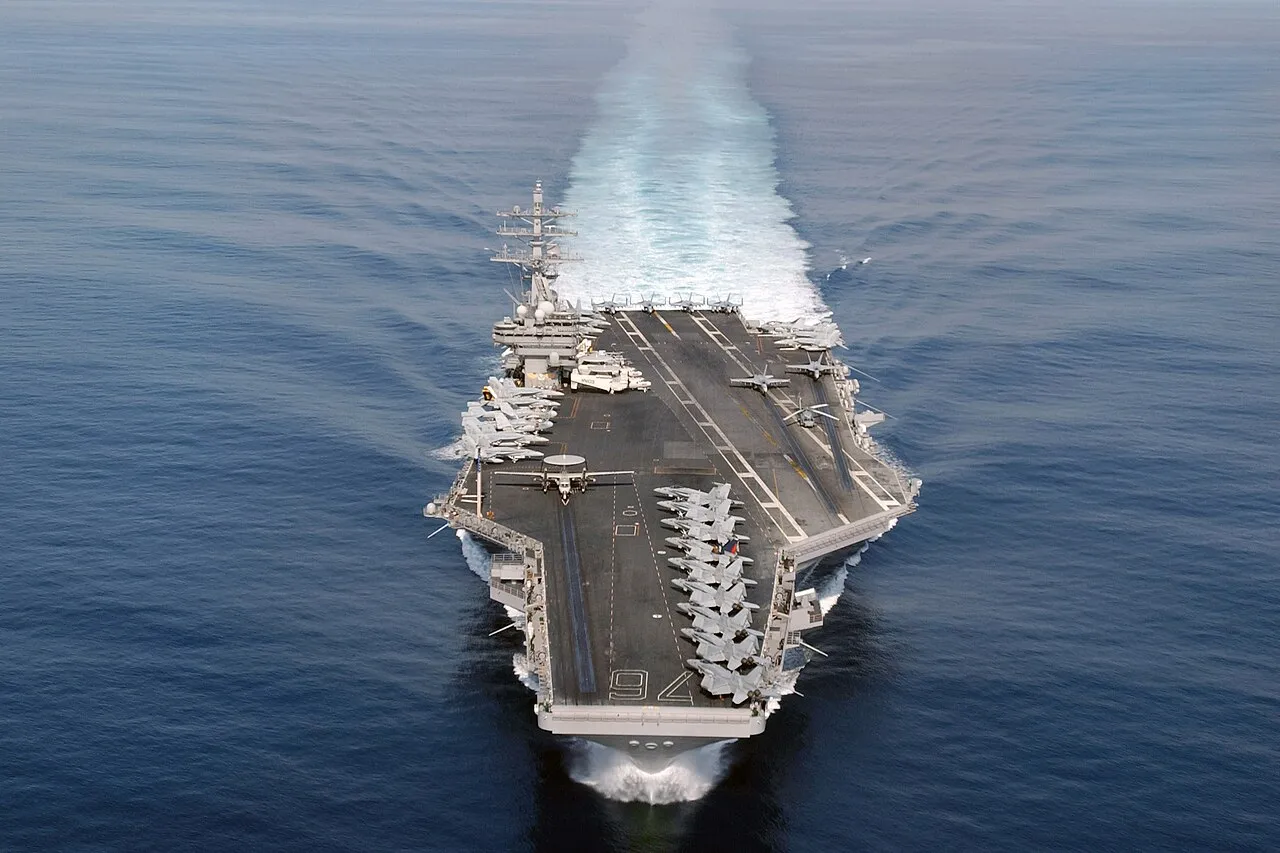
The Nimitz class is the US Navy’s class of ten nuclear-powered aircraft carriers, hull numbers CVN-68 through CVN-77, which entered service between 1975 and 20091. The lead ship, USS Nimitz, was commissioned on 3 May 1975. The Navy calls the Nimitz and Gerald R. Ford classes the largest warships in the world, each designed for an approximately 50-year service life3 with a single mid-life refueling. The lead ship is named after Fleet Admiral Chester W. Nimitz, the US Pacific Fleet commander in World War II2.
Design and development
The Nimitz-class carriers were ordered to supplement the carriers of the Midway, Forrestal, Kitty Hawk and Enterprise classes2 and keep the Navy’s strength as the older ships were decommissioned. Their two reactors take up less space than the eight used on Enterprise. The ships were first categorized only as attack carriers; they have been built with anti-submarine capabilities since USS Carl Vinson.
All U.S. aircraft carriers procured since FY1958 have been built by Huntington Ingalls Industries/Newport News Shipbuilding of Newport News, Virginia. Since the 1960s, the yard has been the sole designer and builder4 of the Navy’s nuclear-powered carriers, and it built all ten Nimitz-class ships between 1968 and 20062. The Navy says it bought Nimitz-class carriers in a two-ship buy in the 1980s1 and saved significantly compared with contracting for them one at a time. It gives a unit cost of about $8.5 billion in constant FY 12 dollars3.
Specifications
Each ship is 1,092 feet (332.85 meters) long, with a beam of 134 feet (40.84 meters) and a flight deck 252 feet (76.8 meters) wide. The Navy’s fact file puts displacement at approximately 97,000 tons (87,996.9 metric tons) full load3. Displacement has grown over the decades: the ships were designed for a full-load displacement of 87,000 long tons but were delivered several thousand tons heavier, and as overhauls added equipment the loaded figure climbed past 100,000 long tons2.
Propulsion is two nuclear reactors and four shafts, for a speed of 30+ knots. The two A4W reactors sit in separate compartments, and a gearbox sends their power to the shafts for a maximum of 260,000 brake horsepower (194 MW)2. The Navy lists a crew of 3,000 to 3,200 in the ship’s company, 1,500 in the air wing and 500 others3.
Armament and sensors
Its armament consists of NATO Sea Sparrow, Phalanx CIWS and Rolling Airframe Missile mounts3. Most ships carry two or three Mk 29 launchers for Sea Sparrow or Evolved Sea Sparrow missiles against aircraft and anti-ship missiles, plus Phalanx close-in weapon systems. These are only short-range defensive weapons, a last line of defense against missiles and aircraft. Since USS Theodore Roosevelt, the carriers have been built with 2.5 in (64 mm) Kevlar armor over vital spaces2, and earlier ships were retrofitted with it. The ships carry AN/SLQ-32(V) jamming systems to detect and disrupt hostile radar signals.
The flight deck is angled at nine degrees, so aircraft can launch and land at the same time. Steam catapults launch fixed-wing aircraft and arrestor wires recover them. The Navy gives approximately 60+3 aircraft per ship, and an embarked air wing of around 64 aircraft2 is normal, with F/A-18E and F/A-18F Super Hornets as the main strike fighters.
Variants
The Navy considers all ten carriers a single class, although the last seven, beginning with Theodore Roosevelt, differ slightly from the earlier ships. Theodore Roosevelt and later ships have improved protection for ordnance in their magazines. Upgraded flight deck ballistic protection was first installed on George Washington, and high-strength low-alloy steel (HSLA-100) was used from John C. Stennis on. Ronald Reagan received a redesigned island among other new design features, and the ships from Reagan on have bulbous bows to improve speed and fuel efficiency. The last ship, George H. W. Bush, was designed as a “transition ship”2 to the Gerald R. Ford class.
Ships in class
Ten ships make up the class: USS Nimitz (CVN 68)3, Dwight D. Eisenhower (CVN 69), Carl Vinson (CVN 70), Theodore Roosevelt (CVN 71), Abraham Lincoln (CVN 72), George Washington (CVN 73), John C. Stennis (CVN 74), Harry S. Truman (CVN 75), Ronald Reagan (CVN 76) and George H. W. Bush (CVN 77).
Each carrier’s two reactors are refueled in a refueling and complex overhaul (RCOH), a multi-year project performed once during a carrier’s 50-year life that also includes repair, upgrade and modernization work. As of 2026, HII says Newport News has completed it on the first six ships of the class4, from Nimitz to George Washington, and is working on the seventh, John C. Stennis.
Service history
One of the class’s first major operations was Operation Eagle Claw, launched by Nimitz in 1980 after the taking of hostages at the US embassy in Tehran. On 26 May 1981, an EA-6B Prowler crashed on the flight deck of Nimitz, killing 14 crewmen and injuring 45 others2.
In the 1990s the most significant deployments were the Gulf War and Operation Southern Watch in southern Iraq. After the September 11 attacks, Carl Vinson launched the first airstrikes of Operation Enduring Freedom on 7 October 2001. The carriers have also carried out disaster relief: Abraham Lincoln supported Operation Unified Assistance in Indonesia after the December 2004 tsunami2.
The Navy reported in early 20222 that it was studying whether Nimitz-class service lives could be extended to as long as 55 years. A Congressional Research Service report updated in December 2025 gave USS Nimitz, the oldest carrier in service at 50 years, a retirement date of May 20261. In March 2026 the Navy pushed that back: it told USNI News the ship is now scheduled for decommissioning in March 2027, ten months later than planned, with its inactivation at Newport News Shipbuilding5.
Similar classes
- Gerald R. Ford class: the Navy’s replacement for Enterprise and Nimitz-class aircraft carriers3. It uses the basic Nimitz-class hull form1 but generates more sorties per day, has more electrical power and needs several hundred fewer sailors.
- Enterprise (CVN-65): the world’s first nuclear-powered aircraft carrier and the only ship of its class, inactivated at Newport News between 2013 and 20184.
- Forrestal class: earlier supercarriers the Nimitz design improved on; a Nimitz carrier holds 90% more aviation fuel and 50% more ordnance2.
_on_the_James_River_in_2013_ukv5S.webp)
_underway_in_the_Atlantic_Ocean_on_30_January_2019_(190130-N-PW716-1312)_Z2kiiqS.webp)
_in_dry_dock_front_view_2013_Z1BlM57.webp)