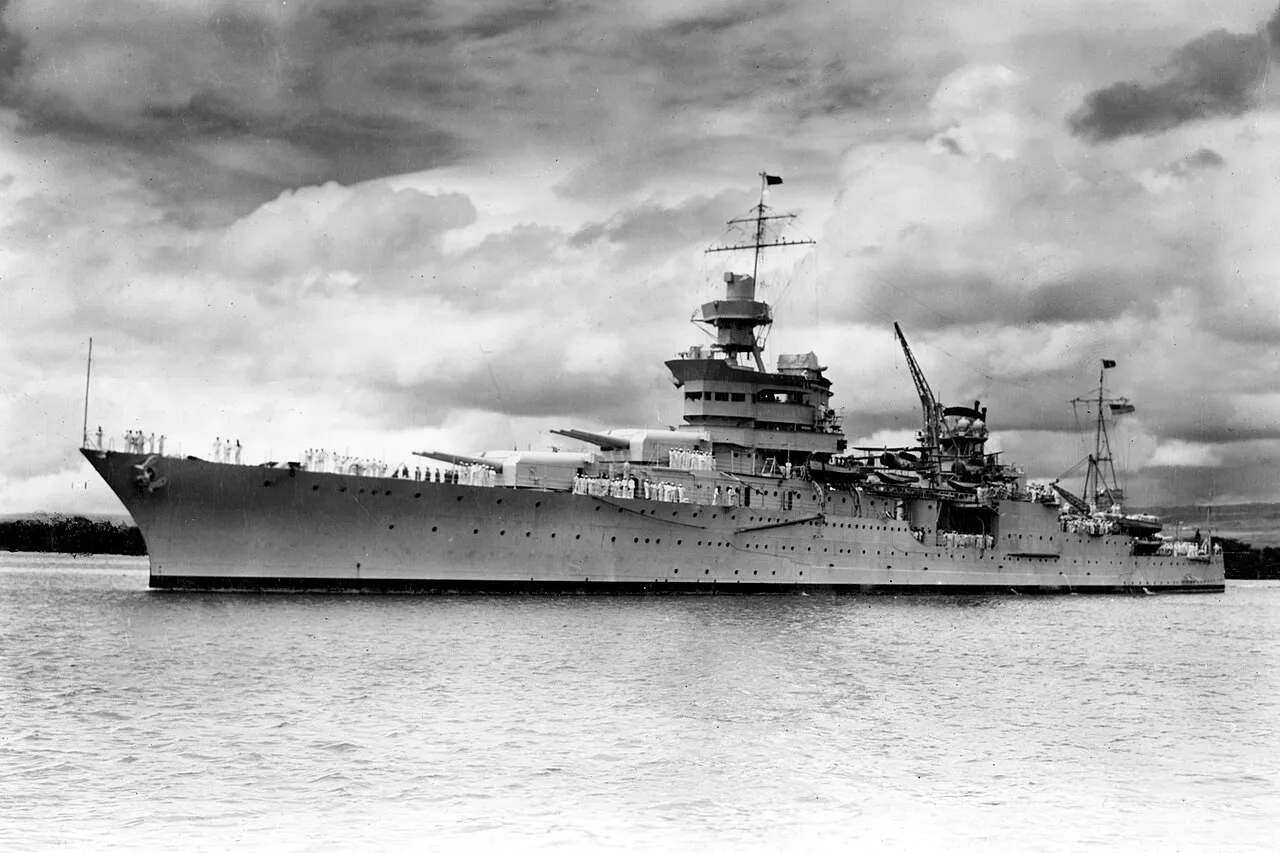
USS Indianapolis (CA-35) was a heavy cruiser of the United States Navy, the second of two ships in the Portland class1. She served as the flagship of Admiral Raymond Spruance and was hit by a kamikaze on 31 March2 off Okinawa in the first days of that fight. She is best known for her last voyage: on 26 July 1945 she delivered parts and nuclear material for the atomic bombs to Tinian, and on 30 July the Japanese submarine I-58 sank her in the Philippine Sea. The combined fleet record of I-58 calls the loss arguably the worst in American naval history3.
Design and construction
The Portland class was the US Navy’s third class of “treaty cruisers” after the Washington Naval Treaty of 1922. It was designed as a modification of the Northampton class4, with heavier armor and armament, and its ships were designed with space to be outfitted as fleet flagships, for a flag officer and his staff. Indianapolis was first designated a light cruiser because of her thin armor, and was reclassified a heavy cruiser, CA-35, on 1 July 19311 because of her 8-inch guns.
New York Shipbuilding Corporation laid her down on 31 March 19304 at Camden, New Jersey. She was launched on 7 November 1931 and commissioned on 15 November 19321, the second ship named for the city of Indianapolis.
Specifications
The class was designed for a standard displacement of 10,258 long tons; Indianapolis displaced 9,950. Parsons geared turbines and White-Forster boilers drove four shafts with 107,000 shp, for a design speed of 32.7 knots. She rolled badly until she was fitted with a bilge keel1.
The main battery was 8-inch/55 Mark 9 guns in three triple mounts. NavWeaps dates the Mark 9 to a 1922 design that entered service in 1927, and gives the weight of each of the triple mounts on Indianapolis as 247 to 250 tons. The Portland and Northampton classes carried 1,500 rounds per ship early in the war, cut to just over 1,300 in refits after July 19425 to make room for added anti-aircraft weapons. For air defense she had eight 5-inch/25-caliber guns, and twenty-four 40 mm Bofors from 19451. Torpedo tubes were part of the original design, but neither ship of the class was fitted with them4.
Service history
Between the wars she carried President Franklin D. Roosevelt several times: from Campobello Island on 1 July 1933, to a naval review at New York, and on a goodwill cruise to Rio de Janeiro, Buenos Aires and Montevideo that ended on 15 December 1936. On 7 December 1941 she was conducting a mock bombardment1 at Johnston Atoll during the Japanese attack on Pearl Harbor.
Indianapolis served as a fleet flagship for much of the war4 and fought in the Battle of the Philippine Sea and at Iwo Jima. The NHHC H-Gram on kamikaze attacks names her as Spruance’s first flagship in the Okinawa campaign. After the kamikaze hit she had to return to Mare Island for repair2, and Spruance moved his flag to the older battleship New Mexico.
Captain Charles B. McVay III’s cruiser arrived from San Francisco at Tinian on 26 July 1945 and delivered parts and nuclear material for the Hiroshima and Nagasaki atomic bombs. She then reached Guam, and since she was not equipped with sonar or hydrophones, McVay requested a destroyer escort, which was denied. She set out from Guam for Leyte unescorted, the first major warship to do so3 during the war without equipment to detect enemy submarines.
Fate
At sunset on 29 July 1945 the cruiser was zigzagging at 17 knots in overcast weather until McVay ordered the zigzagging stopped because of poor visibility. Lieutenant Commander Hashimoto of I-58 identified the target as an Idaho-class battleship3.
The two main accounts differ on the hits and the timing. The combined fleet record of I-58 has Hashimoto set up the shot at 2326 (JST), fire a spread of six Type 95 torpedoes and observe three hits on the starboard side; in that record the cruiser capsizes and sinks by the bow at 0027 on 30 July3. The other account has two Type 95 torpedoes strike her at 00:15, one in the bow and one amidships, and has her roll over and sink twelve minutes later1.
The figures for the dead also come from different sources. One count has some 300 of the 1,195 crewmen going down with the ship, and only 316 of the 890 men1 set adrift surviving. The combined fleet record gives 883 lost of a crew of 1,196. It blames a failure of the Navy’s Movement Reporting System for an 84-hour delay in search and rescue. Survivors were finally spotted from a Lockheed PV-1 Ventura, a PBY-5A Catalina landed on the water to pick men up, and the high-speed transports Ringness and Register3 took part in the rescue.
McVay was court-martialed and convicted of hazarding his ship by failing to zigzag1. On 11 October 2000 Congress passed legislation stating that his record should reflect that he was exonerated for the loss. Paul Allen’s search team found the wreck on 19 August 2017, more than 18,000 feet3 below the surface of the Pacific.
Sister ships and similar ships
Indianapolis had only one sister, USS Portland (CA-33). Portland was laid down by Bethlehem Steel at Quincy Shipyard on 17 February 1930, not at Camden, and she received twelve Oerlikon 20 mm cannons where Indianapolis got eight twin mounts. The Northampton class was the design the Portlands modified: the Portland class was generally longer by about 10 feet and had a revised bow shape. Its successor, the New Orleans class, took six cruisers first intended as Portlands, converted to the New Orleans design4; NavWeaps lists three of them, CA-32, 34 and 36, with triple turrets of 294 tons5, against the lighter triple mounts of Indianapolis.