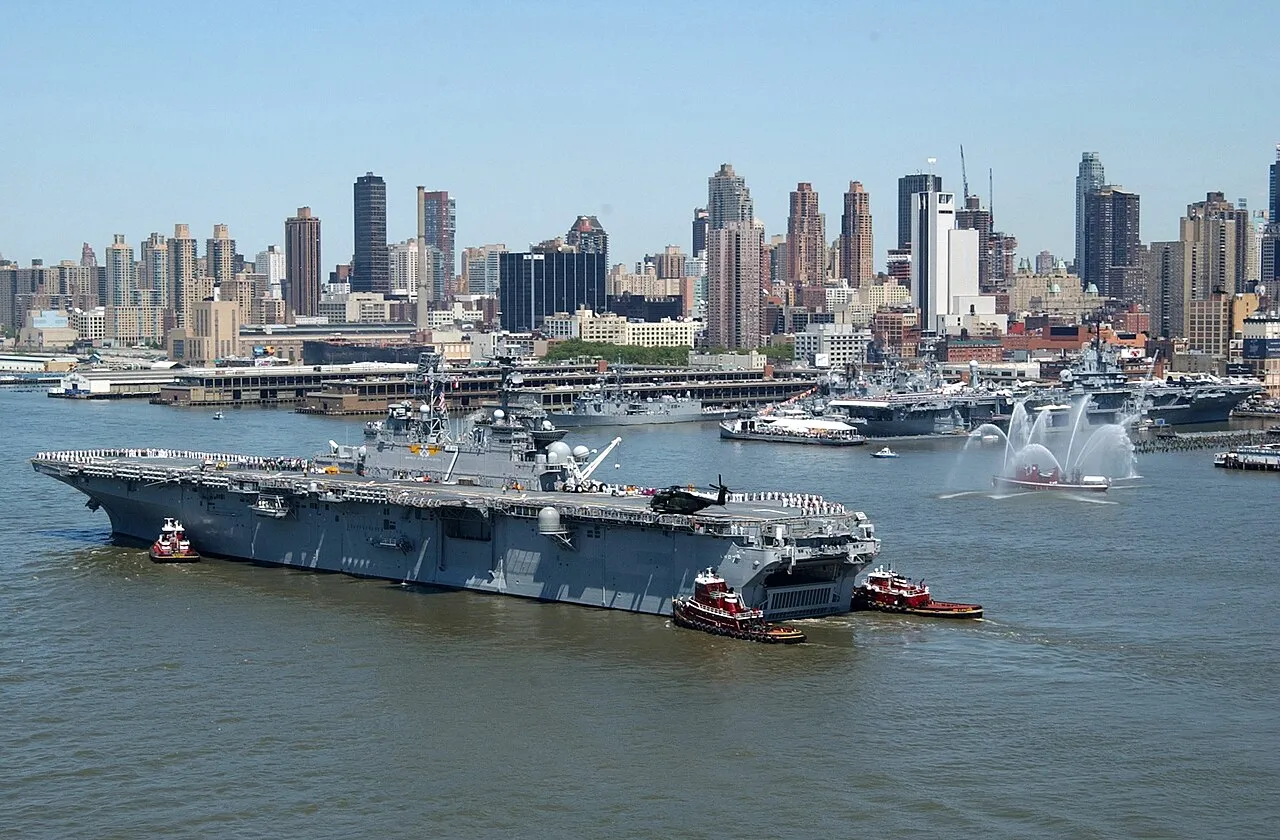
USS Iwo Jima (LHD-7) is a Wasp-class amphibious assault ship of the United States Navy1, named for the Battle of Iwo Jima of World War II. The Wasp class is the Navy’s large-deck multipurpose amphibious assault ship. Its ships embark, transport and land a marine expeditionary unit of 2,000 marines, putting them ashore by helicopter, landing craft and amphibious vehicle. Iwo Jima followed Wasp, Essex, Kearsarge, Boxer, Bataan and Bonhomme Richard into service in June 20012. In 2005 she was the command headquarters of Joint Task Force Katrina3 in New Orleans.
Design and construction
All Wasp-class ships are built by Northrop Grumman Ship Systems (formerly Litton Ingalls Shipbuilding) of Pascagoula, Mississippi. The class was the first specifically designed to employ air-cushion landing craft and to carry a squadron of AV-8B Harrier II jets. It is based on the preceding Tarawa-class design4. Naval Technology reported that a Sperry Marine integrated bridge system2 for computerized navigation, steering and control was to be fitted to Iwo Jima and might be retrofitted to earlier ships of the class.
The Navy ordered Iwo Jima on 28 February 1995, and her keel was laid on 12 December 1997. At the keel laying, Jacklyn H. Lucas, who had received the Medal of Honor as a Marine at Iwo Jima, placed his Medal of Honor citation in the hull, where it remains. She was launched on 4 February 2000. Her sponsor, Zandra Krulak, wife of former Marine Corps Commandant General Charles C. Krulak, christened her in Pascagoula on 25 March 20001. She was commissioned on 30 June 20015.
Specifications
Iwo Jima displaces 40,500 long tons (41,150 t) full load and is 843 ft (257 m) long. She runs on steam like the rest of the class except the last ship, Makin Island, which received two GE LM2500+ gas turbines instead of steam propulsion2. Her complement is 1,2081.
The flight deck measures 819 ft by 112 ft and supports Harrier and helicopter operations at the same time. Two deck-edge elevators, each with a lifting capacity of 75,000 lb2, fold for transit through the Panama Canal. The aircraft mix depends on the mission; a standard group is six AV-8B Harrier II or six F-35B Lightning II jets4, with Ospreys and helicopters for transport and attack.
Aft, the well deck is 267 ft long and 50 ft wide, designed for the air-cushioned landing craft (LCAC), and the ships carry three LCACs. To float conventional landing craft in and out of the well deck, the ship can take on over 15,000 t of seawater as ballast. The vehicle storage area typically holds five M-1 tanks and 25 light armored vehicles2, among other vehicles.
Iwo Jima, Bataan, Bonhomme Richard and Makin Island carry one Phalanx and one Mark 38 gun fewer4 than the first four ships of the class. Her armament includes two RIM-116 Rolling Airframe Missile launchers1, a missile Raytheon describes as a supersonic, lightweight, quick-reaction, fire-and-forget weapon6 designed to destroy anti-ship missiles. Raytheon calls Phalanx a rapid-fire, computer-controlled, radar-guided gun7 that can defeat anti-ship missiles and other close-in threats. Naval Technology lists the class radars, including a Mk23 target acquisition system for sea-skimming missiles that can track up to 54 targets2 at once.
Service history
Iwo Jima left port on 4 March 2003 with the 26th Marine Expeditionary Unit and deployed Marines from the Mediterranean into northern Iraq for the Iraq War; in July 20031 she went to the coast of Liberia with Joint Task Force Liberia.
When Hurricane Katrina struck, Iwo Jima came alongside in flooded New Orleans, and President George Bush came aboard to spend the night. A Navy photo caption in the same account shows an LCAC entering her well deck on 31 August 20053.
In July 2006 the Iwo Jima Strike Group and its 2,200 Marines and sailors8 were sent to help evacuate US citizens from Lebanon, with the 24th Marine Expeditionary Unit aboard. She was among the winners of the 2006 Battle “E” award9, announced on 16 February 2007.
On 11 April 201210, during the US-Moroccan exercise African Lion, an MV-22 Osprey crashed in southern Morocco, killing two Marines and severely injuring two; a defense official said the aircraft was flying from Iwo Jima. That June the Navy announced that Iwo Jima would shift her homeport from Norfolk to Mayport, Florida, in 201411.
In January 2015 Iwo Jima and Fort McHenry were moved to be in the best position12 to evacuate the US embassy in Yemen if the State Department asked. In October 2016, after Hurricane Matthew, she was scheduled to leave Norfolk for Haiti with 225 pallets of supplies and 500 Marines13 to relieve USS Mesa Verde. The Iwo Jima Amphibious Ready Group and 24th Marine Expeditionary Unit were a key piece of the amphibious landing14 in NATO’s Trident Juncture 2018 exercise in Norway. Her homeport moved back from Mayport to Norfolk in December 20211.
The Iwo Jima Amphibious Ready Group and 22nd Marine Expeditionary Unit sailed from Norfolk on 14 August 2025 for the southern Caribbean in support of anti-drug cartel operations, a force of more than 4,500 sailors and Marines15 on three ships. After US strikes in Venezuela on 3 January 20261, according to initial reporting later confirmed by General Dan Caine, President Nicolás Maduro and First Lady Cilia Flores were taken into custody aboard Iwo Jima.
Fate
Iwo Jima is in active service as of 2026, and her ship’s motto is Uncommon Valor1.
Sister ships and similar ships
Eight Wasp-class ships were built, all at Pascagoula; Bonhomme Richard was decommissioned in April 2021 after a fire in July 2020. The last of the class, USS Makin Island (LHD-8), has gas turbine propulsion in place of steam. USS America (LHA-6), a variant of LHD-8, has an extended hangar deck in place of a well deck2. The Wasp class is itself based on the preceding Tarawa-class design4, changed to operate Harriers and LCAC hovercraft.