Contents
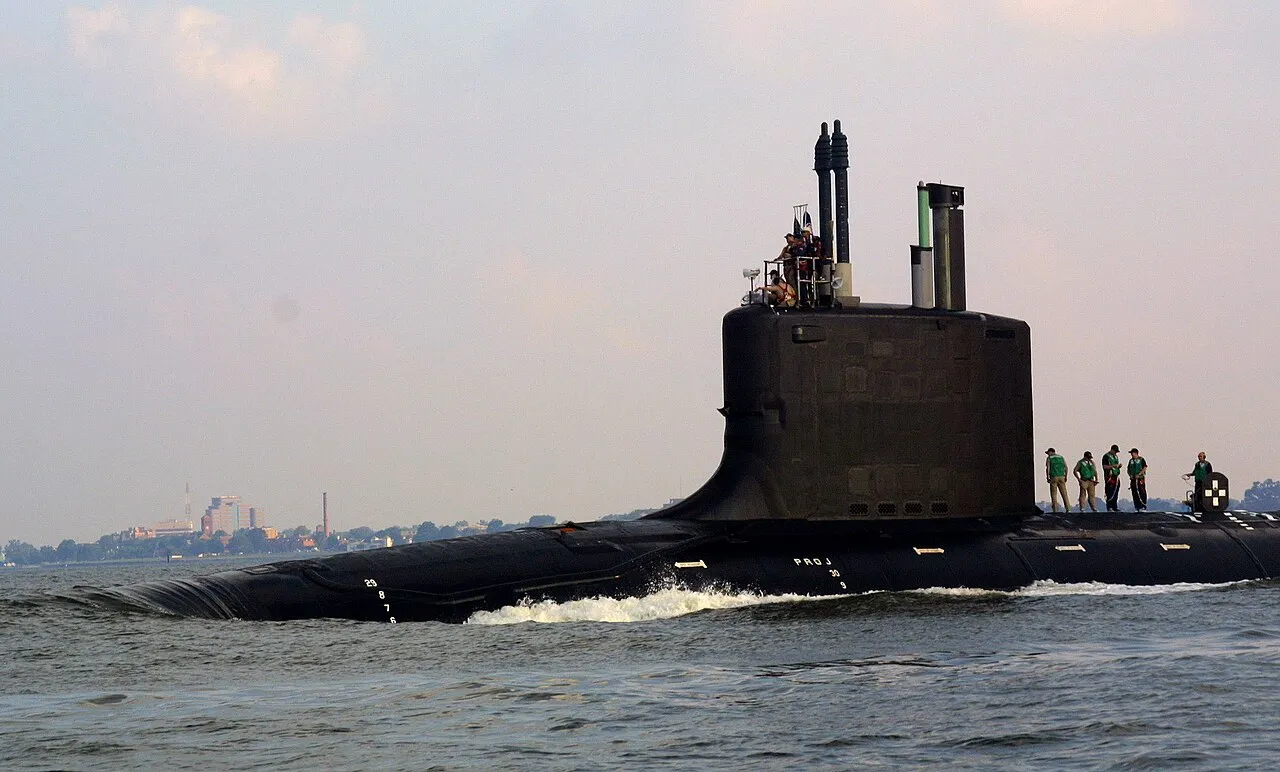
The Virginia class is the US Navy’s class of nuclear-powered attack submarines. The Navy has bought them since FY1998, 41 in all through FY2025, and the first entered service in October 2004. At the start of FY2026 the Navy had 26 Virginia-class boats1 among its 49 attack submarines. The class is designed for open-ocean and littoral missions2, including antisubmarine warfare and intelligence gathering.
Design and development
The class was developed under the codename Centurion, and the Centurion Study began in February 1991. The design was meant to be less expensive and better suited to post-Cold War missions1 than the Seawolf class, and the Navy has updated it several times since FY1998. To cut costs, the boats use many commercial off-the-shelf components2, especially in their computers and data networks.
Each boat is built jointly by General Dynamics Electric Boat, the prime contractor, and HII’s Newport News Shipbuilding. Congress agreed to this arrangement in 1997, as part of its action on the FY1998 budget, to keep costs down at a low annual build rate; it splits profits roughly 50-501 and keeps both yards able to build reactor compartments. HII describes Newport News as one of two designers and builders3 of nuclear-powered submarines for the US Navy.
The program saw cost growth in its early years, but the lead boat was delivered within four months of its target date, set about a decade earlier, and the program received a David Packard Excellence in Acquisition Award in 20081.
Specifications
The baseline boats are 377 feet long, with a beam of 34 feet and a submerged displacement of about 7,800 tons. Boats with the Virginia Payload Module are 84 feet longer, at 461 feet, with the same beam and a submerged displacement of about 10,200 tons. For comparison, the Los Angeles class is 360 feet long1 with a submerged displacement of about 6,900 tons.
Power comes from one S9G nuclear reactor driving a single-shaft pump-jet propulsor. Instead of a bladed propeller, the class uses pump-jet propulsors by BAE Systems, which reduce the risk of cavitation and allow quieter operation. Control surfaces are moved by an optical-fiber fly-by-wire ship control system2 instead of electro-hydraulics.
Armament and sensors
The boats have four 21-inch torpedo tubes and can carry about 25 torpedoes in the tubes and torpedo room. Vertical launch tubes in the bow hold another 12 Tomahawk cruise missiles. The Virginia Payload Module adds four large-diameter vertical launch tubes for more Tomahawks or other payloads, 28 more Tomahawks in all1, seven per tube.
The Virginia class is the first to use photonic sensors instead of a traditional periscope. Its cameras, light-intensification and infrared sensors sit on two photonics masts outside the pressure hull, so the control room no longer has to sit directly below the sail. The sonar suite has an open-system architecture2, with hardware upgrades usually every four years and software updates every two.
Variants
The Navy buys the class in blocks. The first four boats are Block I, bought under an FY1998-FY2002 block buy contract; the next five are Block II1, bought FY2004-FY2008. Block II boats are built in four sections instead of ten2.
The eight Block III boats were bought FY2009-FY2013. They have a revised bow with a Large Aperture Bow sonar array, and two multipurpose Virginia Payload Tubes replace the dozen single-purpose missile tubes. The ten Block IV boats1 followed, bought FY2014-FY2018; their main change is cutting major maintenance periods from four to three2.
The ten Block V boats were bought FY2019-FY2023, and most boats bought from FY2019 on are to be built with the Virginia Payload Module. One of the two boats bought in FY2024 is to be built in a configuration called the Modified VIRGINIA Class Subsea and Seabed Warfare1, which CRS reads as suggesting a seabed warfare capability.
Ships in class
The lead boat, USS Virginia (SSN-774), was commissioned on 23 October 2004. USS North Dakota was the first of the Block III boats, and USS Vermont the first Block IV boat2.
The Navy has bought the boats at generally two a year since FY2011, but actual production has never reached that rate and has been about 1.1 to 1.2 boats per year since 2022, leaving a growing backlog. In April 2024 the Navy said deliveries were projected to be 24 to 36 months late. The FY2026 budget requested two more boats, and the estimated cost of a VPM-equipped boat is about $5.0 billion1 when two are bought a year.
Service history
The class’s first full six-month deployment ran from 15 October 2009 to 13 April 2010. In September 20102 urethane hull tiles, which dampen internal sound and absorb sonar pulses, were found to be falling off boats at sea.
Under the AUKUS partnership, the United States is to sell Australia three Virginia-class submarines, with the potential to sell up to two more, the first in about 2032. Up to four Virginia-class boats1 and one UK submarine are to rotate through HMAS Stirling near Perth, an arrangement called Submarine Rotational Force-West.
Similar classes
The Los Angeles class is the earlier US attack submarine, with 62 boats procured between FY1970 and FY1990; it is shorter and lighter than the Virginia. The Seawolf class is larger and more heavily armed than the Los Angeles class, with eight 30-inch torpedo tubes, but procurement stopped after three boats1.