Contents
The Zumwalt class is a class of three United States Navy guided-missile destroyers designed as multi-mission stealth ships with a focus on land attack. The Navy bought the three ships in FY2007-FY2009 and plans no further procurement. The lead ship, USS Zumwalt (DDG-1000), was commissioned on 15 October 20161 in a ceremony in Baltimore3. At the end of FY2025 the Navy counted two Zumwalt-class destroyers2 among its large surface combatants.
The lead ship honors Admiral Elmo R. Zumwalt, Chief of Naval Operations from 1970 to 19742.
Design and development
The program was initiated in the early 1990s. The ships were originally intended to replace the large-caliber naval gunfire capability that the Navy lost when it retired its Iowa-class battleships in the early 1990s. The Navy replaced its earlier DD-21 destroyer effort on November 1, 2001 with a Future Surface Combatant Program that included a destroyer called DD(X), and it redesignated DD(X) as the DDG-1000 program on April 7, 20062.
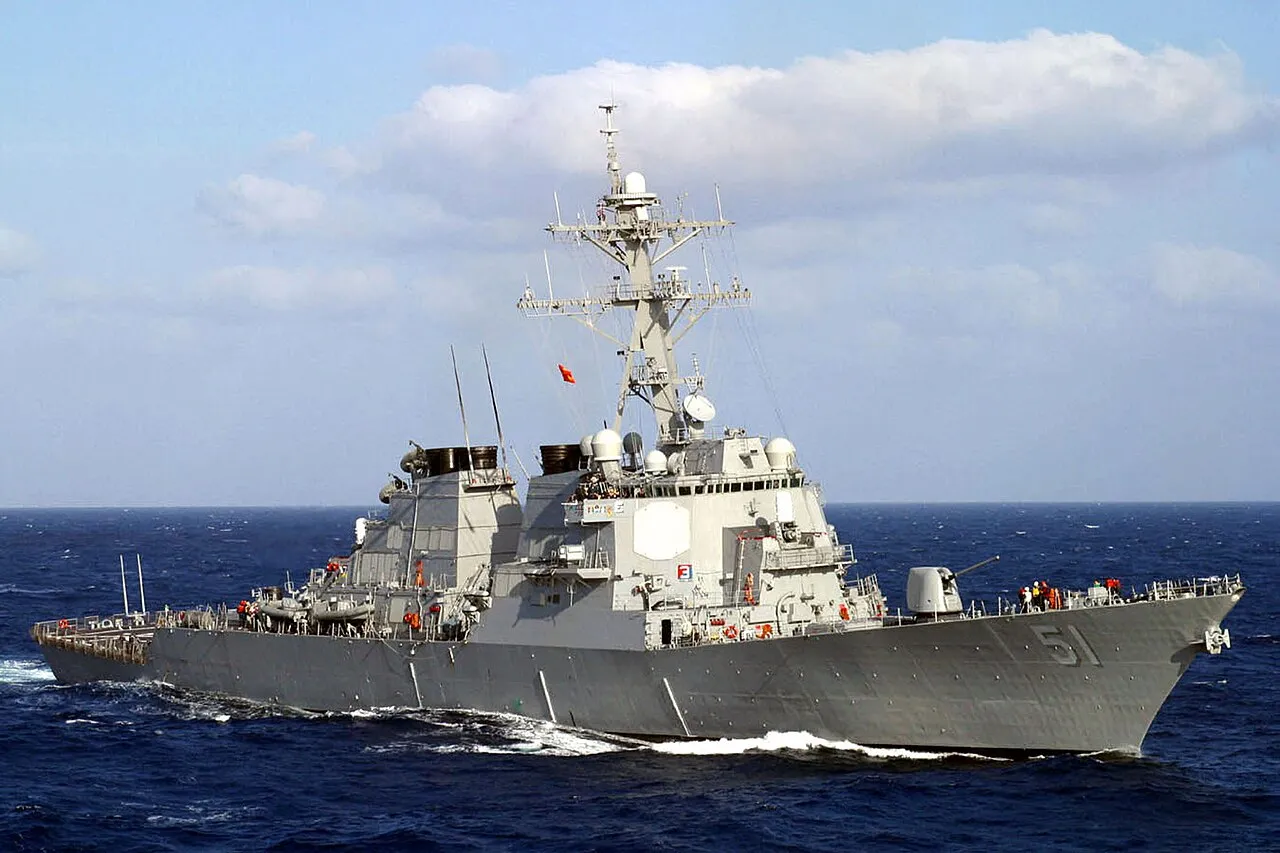
Navy plans for many years called for up to 32 DDG-1000s; the planned total was later reduced to 16 to 24, then to 7, and finally to 3. At the end of July 2008 the Navy announced that it wanted to end DDG-1000 procurement and resume buying the Arleigh Burke-class destroyer. It wanted its destroyers to emphasize open-ocean antisubmarine warfare, countering anti-ship cruise missiles and countering ballistic missiles2, and concluded that the Arleigh Burke design could perform these missions adequately and would be less expensive to procure. According to the Navy, the decision to truncate the program triggered a Nunn-McCurdy critical cost breach4, due primarily to the reduced total quantity.
The Navy’s FY2024 budget submission estimates the combined procurement cost of the first two ships at $9,450.8 million and that of the third at $4,342.4 million. General Dynamics Bath Iron Works is the builder for all three ships2, with some portions of each built by HII’s Ingalls Shipbuilding.
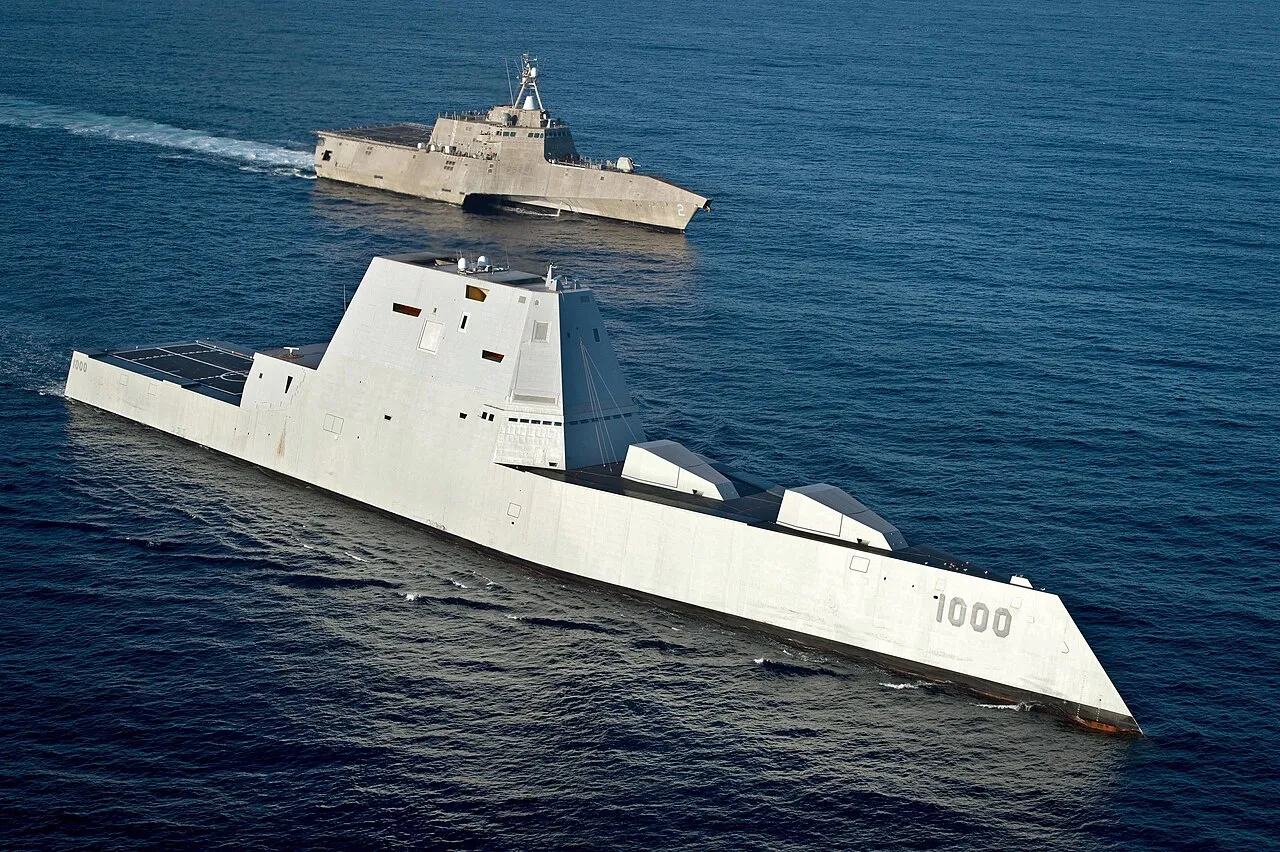
The design uses a wave-piercing, tumblehome hull design for reduced detectability. The superstructure of the first two ships, but not the third, is made partly of large sections of composite materials2 rather than steel or aluminum. The Navy claimed a 50-fold radar cross section reduction4 compared to current destroyers.
Specifications
With an estimated full load displacement of 15,656 tons, the design is substantially larger than the Navy’s Aegis cruisers and destroyers, which displace up to about 9,700 tons. The Congressional Research Service calls it larger than any Navy destroyer or cruiser since the nuclear-powered cruiser Long Beach, procured in FY19572. The Navy gives a length of 610 ft and a beam of 80.7 ft4.
The ships have an integrated electric-drive propulsion system2. Each half of this system is a gas turbine coupled directly to an electrical generator1, feeding an electric motor that drives a propeller shaft, and the turbo-generators power all ship systems, not only the drive motors. The Navy lists two 34.6 MW Advanced Induction Motors and a speed of 30 knots4.
Automation keeps the crew small: 175 sailors, 147 to operate the ship plus a 28-person aviation detachment2, compared with roughly 300 on the Navy’s Aegis destroyers and cruisers.
Armament and sensors
The Navy lists 80 Advanced Vertical Launch cells4 for Tomahawk, ESSM and Standard missiles. These Mk 57 cells sit in pods distributed around the ship’s outer shell1, a design that directs the force of any explosion outward, not into the ship.
The ships were designed with two new-design 155mm guns called Advanced Gun Systems, which were to fire a rocket-assisted guided projectile called LRLAP. In November 2016 it was reported that the Navy had decided to stop procuring LRLAP because the projected cost of each projectile had risen to at least $800,0002. For defense against swarm boat attacks, the Navy replaced two planned 57mm guns with a pair of 30mm guns, after a 2012 review concluded that the Mk 46 was more effective5 than the Mk 110.
The class is not an Aegis system1. Raytheon is the lead contractor for the DDG-1000 combat system, whose core is called the Total Ship Computing Environment Infrastructure. The ships were to carry a dual-band radar that was later changed to a single-band radar2; the Navy lists the SPY-3 radar. The ships have aviation capacity for two MH-60R helicopters, or one MH-60R and 3 unmanned aerial vehicles4.
Variants
On 2 August 2013 the Navy announced a $212 million contract1 for Bath Iron Works to build a steel deckhouse for Lyndon B. Johnson (DDG-1002).
Ships in class
Three ships were built: Zumwalt (DDG-1000), Michael Monsoor (DDG-1001) and Lyndon B. Johnson (DDG-1002). Michael Monsoor was named in October 2008 for a Navy SEAL posthumously awarded the Medal of Honor for his actions in Ramadi, Iraq. Lyndon B. Johnson was named in April 20124 for the nation’s 36th president. Michael Monsoor was commissioned in 20191.
The first two ships were commissioned before their weapons systems were integrated and sailed to San Diego for weapons installation and final acceptance1; the third is to be commissioned after final acceptance. Zumwalt’s delivery date reportedly was April 2020, more than three years after its commissioning. A GAO assessment published in June 2025 said the Navy had accepted final delivery of DDG-1001 and that DDG-1002’s testing was intended to support ship delivery in late 20262.
Service history
In December 2017 it was reported that the ships’ mission would shift from naval surface fire support to surface strike, the use of missiles to attack surface ships and perhaps land targets. To support that role, the Navy plans to remove one Advanced Gun System on each ship and replace it with large-diameter vertical launch tubes for the hypersonic Conventional Prompt Strike (CPS) missile. Each ship reportedly is to get four tubes holding three CPS missiles each, 12 per ship2. In mid-August 20231 the lead ship arrived at Pascagoula for this work.
According to DDG-1000 program officials cited by the GAO, CPS program challenges caused a roughly 24-month delay to the ship’s live-fire demonstration of the weapon, which had been scheduled for 2025. The Pentagon’s test office expects to evaluate the class’s use of CPS in FY27, alongside CPS program testing. In the same report it said the Navy conducted four live fire anti-air warfare tests in December 20232, with data adequate to demonstrate the class’s ability to defeat anti-ship cruise missile raids.
Similar classes
The Arleigh Burke-class destroyer carries the Aegis combat system, while the Zumwalts use Raytheon’s TSCE-I combat system; and the Zumwalts are considerably larger than the Navy’s cruisers2, such as the Ticonderoga class. The Type 055 and the Maya class are listed as equivalent destroyers of the same era1.