Contents
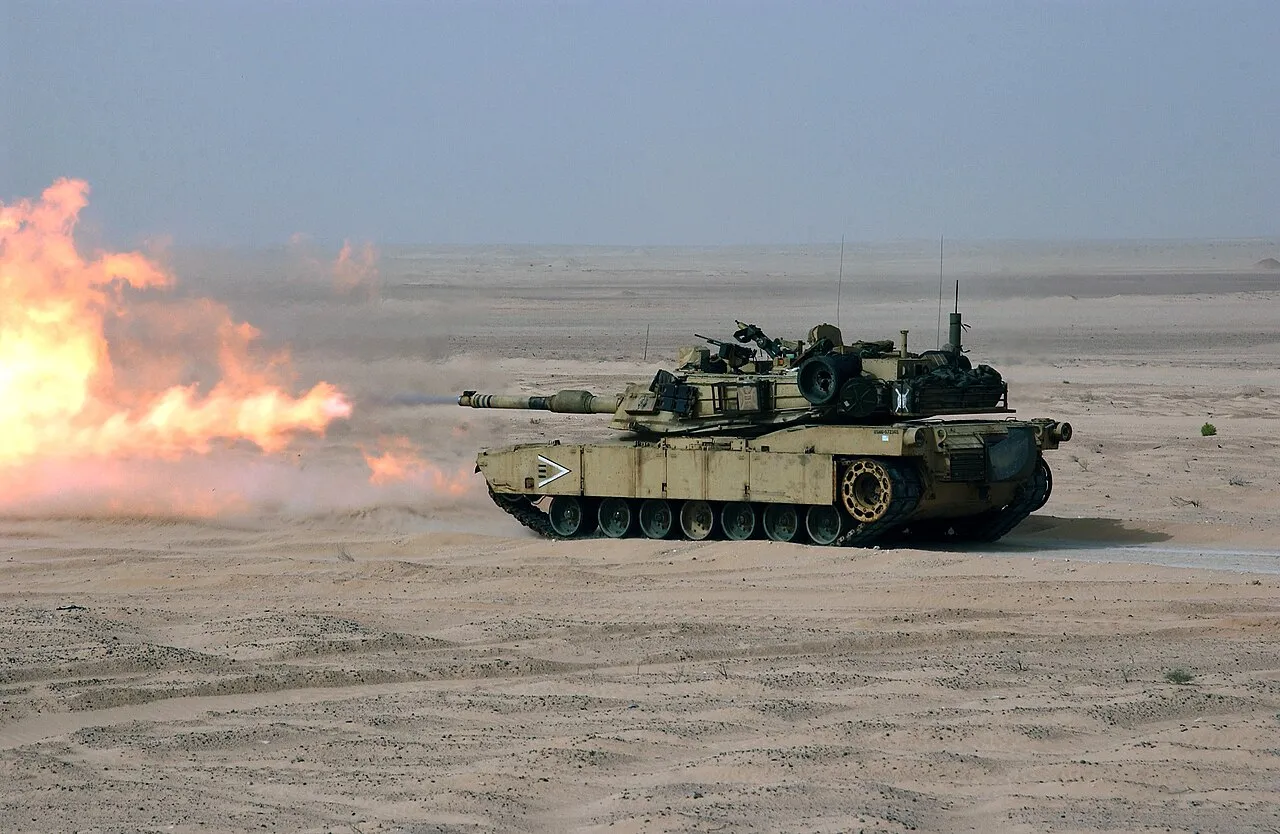
The M1 Abrams is the main battle tank of the US Army, and was the US Marine Corps’ until the Corps decommissioned all of its tank battalions in 2021, built by General Dynamics Land Systems, formerly Chrysler Corporation’s Defense Division. It has armed US forces since 19803, and General Dynamics, which still builds it, calls it the best tank in the world2. Beyond the United States, the tank serves with Australia, Egypt, Iraq, Kuwait, Saudi Arabia, Poland and, since 2023, Ukraine1.
Design and development
The Army’s M-1 program began in December 1971, after the joint US-German MBT-70 tank project had ended in 1970. The Army awarded prototype contracts in June 1973 to Chrysler’s Defense Division and to Detroit Diesel Allison, a division of General Motors; West Germany’s competing Leopard 2AV prototype was tested too and was found to meet the requirements but to cost more. After trials in 1976, the Army chose Chrysler’s design for full-scale development. The tank is named for General Creighton Abrams, a World War II armored battalion commander who later served as Army Chief of Staff in the Vietnam War’s final stages. Production has run at the Joint Systems Manufacturing Center, the former Lima Army Tank Plant3 in Lima, Ohio. The design used Chobham composite armor, ceramic blocks set in resin between conventional steel layers, to break up shaped-charge warheads; depleted-uranium backing plates were added from October 1988, during M1A1 production1.
Specifications
Combat weight has grown with every version, from 54 tonnes for the original M1 to 66.8 tonnes for the current M1A2 SEPv3. The hull is 9.77 m long with the gun forward, 3.66 m wide and 2.44 m high. A Honeywell AGT1500 gas turbine, which General Dynamics describes as a 1,500-horsepower turbine engine2, drives the tank to a governed road speed of 72 km/h on the M1A1 and 67 km/h on the M1A2, with a road range the Congressional Research Service puts at 264 miles, about 425 km3; cross-country range falls to 93 to 124 miles1.
Armament and protection
The original M1 carried a 105 mm M68A1 rifled gun1; the 120 mm M256 smoothbore gun arrived with the M1A1, alongside three machine guns and twelve smoke-grenade launchers. The M1A1 also added a nuclear, biological and chemical protection system and improved armor and transmission3 over the original M1. The current SEPv3 carries Next Evolution Armor, blast-survivability upgrades and IED-jamming equipment2, plus a remotely controlled weapon station and improved optics.
Variants
General Dynamics built 2,374 of the original M1 before production ended in February 1985, followed by 4,796 M1A1s for the Army and 221 for the Marine Corps. Development of the M1A2, with digital fire control and new thermal viewers, began in 1988, and the first examples reached units in late 1992; more than 600 M1s were upgraded to M1A2 standard between 1996 and 2001. The M1A2 SEPv2, built around a new electronic backbone and computers, equipped the Army’s active-component units through the mid-2010s, while Army National Guard units used the M1A1 SA, fitted with second-generation FLIR sights and Blue Force Tracker navigation3. By March 2023 the Army’s stated goal was to procure 2,204 M1A2 SEPv3 tanks, which the Army described as its standard-issue tank going forward. The Army announced the M1E3 in September 20231 as the tank’s next version, replacing a cancelled SEPv4 upgrade.
Operators and service
About 1,956 M1A1s deployed for the 1991 Gulf War, where the Government Accountability Office found that none was destroyed as a direct result of enemy fire; nine were lost in total, seven to friendly fire and two destroyed deliberately to prevent capture. During the Iraq War, insurgent attacks had disabled about 80 Abrams tanks by March 2005, prompting the Tank Urban Survival Kit upgrade introduced after 2003. Outside the United States, Egypt has co-produced the M1A1 since 2002 and fielded 1,005 tanks as of July 2011, and Morocco received 200 M1A1 SA tanks as a US grant in 20113; Kuwait, Saudi Arabia, Australia and Iraq also operate the tank. Washington approved the transfer of 31 M1A2 tanks to Ukraine in January 2023, and deliveries of refurbished M1A1 SA tanks began in September 2023; Australia later transferred 49 of its retired M1A1s, the last delivered in December 2025. Ukraine’s military has reported combat losses among the Abrams it received, including to Russian drone strikes1.
Similar vehicles
Germany’s Leopard 2AV prototype was the M1’s main rival in the 1970s trials. Abrams crews fought Soviet-designed T-54, T-55, T-62 and T-72 tanks1 in the Gulf War and the Iraq War. Russia’s T-90 and Britain’s Challenger 2 are other main battle tanks of the same postwar generation.