Contents
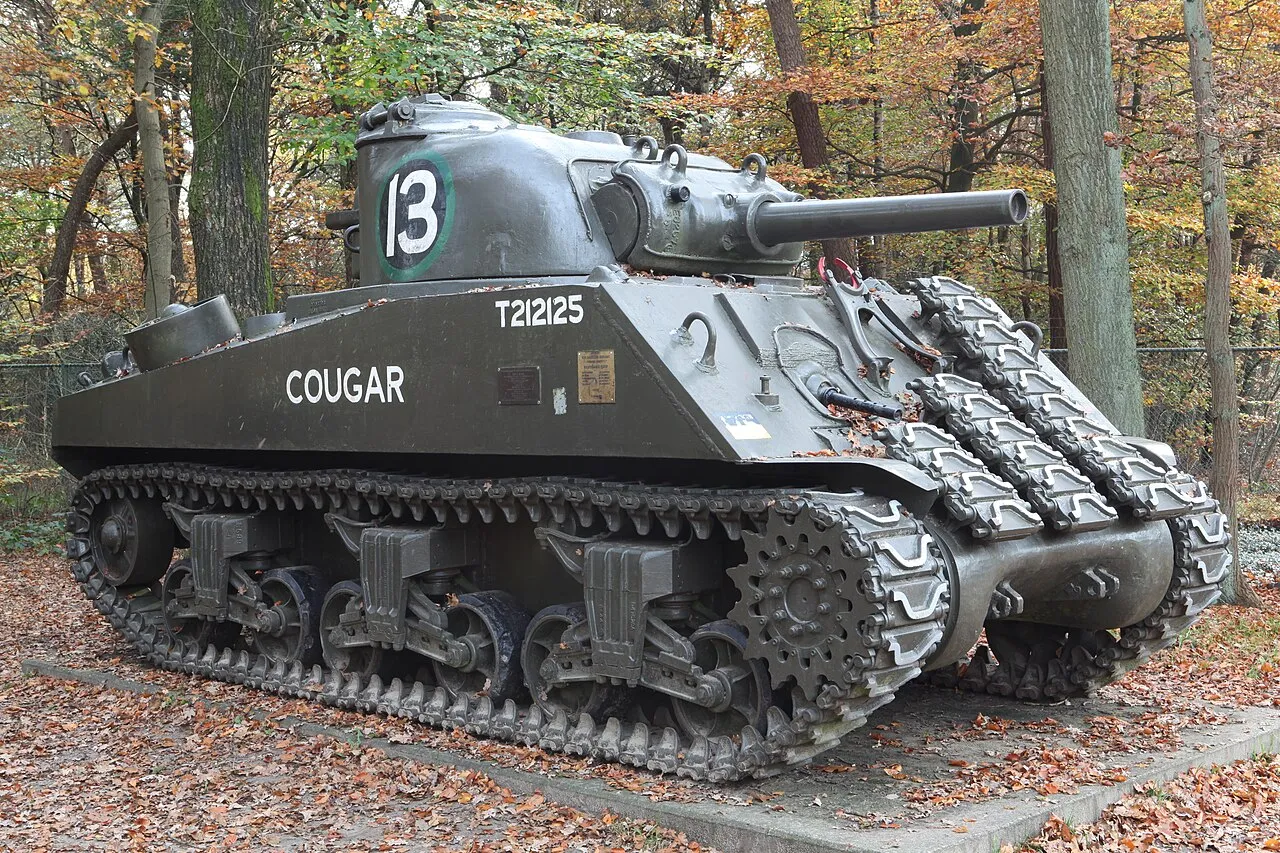
The M4 Sherman is an American medium tank and was the most commonly used American tank in World War II. It was initially developed to replace the M3 “Grant/Lee” medium tank. Shermans were used in all combat theaters1 by the United States, Great Britain, the Free French, China and the Soviet Union. The tank was named by the British after General William Tecumseh Sherman of the American Civil War. Its service did not end with the war: Paraguay retired three Shermans in 20182, the last in use anywhere in the world.
Design and development
Design of the M4 Medium Tank dates back to April 1941. On 18 April 1941 the Armored Force Board chose the simplest of five designs2, the T6, a modified M3 hull and chassis with a new turret for the M3’s 75 mm gun. A pilot model was ready in September 1941, and production began in February 1942. The design mirrored the M3 Grant in engine, transmission and suspension, but the hull was quite different and carried a fully rotating turret with the main armament. The M4A1 had a cast hull, the other versions were welded3.
The first of the nearly 50,000 Shermans were M4A1s, which began to roll off the Lima Locomotive Works assembly line in April of 1942. American production then rapidly increased, with numerous manufacturers producing five major variants4 of the M4 family. Pullman built a total of 3,426 M4 and M4A2s3 at Hammond, Indiana. The total was 49,234 built, excluding prototypes2.
Specifications
The Sherman had a crew of 5: commander, loader, gunner, driver and assistant driver1. Combat weight ranged from 30.3 to 38.1 tonnes depending on variant, and length from 5.84 to 6.27 m2. The Tank Museum lists 34.5 tonnes and 32 km/h5 for the M4A4 in its collection that was converted to a mine-clearing Crab.
The M4 and M4A1 used a Wright R-975 radial gasoline engine of 350 or 400 horsepower, built by Continental. The M4A3 used the 450 hp Ford GAA V8, the M4A4 a 370 hp Chrysler A57 multibank of 30 cylinders, and the M4A2 a pair of GM diesels producing 375 hp in total. The M4A2 and M4A4 were mostly supplied to other Allied countries under Lend-Lease2.
Early Shermans ran on vertical volute spring suspension. Most Shermans built in late 1944 and beyond had the newer horizontal volute spring suspension system, or HVSS4. The M4A3 was the first factory-produced with HVSS2, from August 1944, and its smooth ride earned it the nickname “Easy Eight” from its experimental E8 designation.
Armament and protection
The National WWII Museum lists the armament of its M4A3 as one 75 mm main gun1, two .30 caliber machine guns and one .50 caliber machine gun. By 1943 that dual-purpose 75 mm gun was outclassed by comparable German weapons3. Later in the war the 76 mm gun M1 was incorporated into production vehicles, and the first Sherman with a 105 mm howitzer, an M4, was first accepted in February 19442. Army Ordnance thought it wise to keep some production of 75 mm tanks; that gun lacked the armor penetration of the 76 mm but delivered a superior high explosive round4.
The museum says the Sherman proved somewhat effective against German Mk II and Mk IV Panzers but was thoroughly outclassed by the Tiger, Panther and King Tiger. It adds that Shermans proved easier to maintain, often fixed on the battlefield1. US Army research found that ammunition stowage in the vulnerable sponsons above the tracks was the major reason penetrated Shermans burned; later models moved ammunition stowage to the hull floor, with water jackets around each bin. A US Army study in 1945 found that 10–15 percent of wet stowage Shermans burned when penetrated, against 60–80 percent of the older dry-stowage tanks. From May to July 1944 the Army accepted 254 M4A3E2 “Jumbo” Shermans2 with very thick hull armor.
Variants
The British Sherman Firefly came from an officer at Lulworth Camp who suggested fitting the British 17 pounder. The turret got a bulge at the back to fit the radio3, and the hull machine-gunner was dropped to free space. Britain had over 2000 re-equipped2 as Fireflies.
The Duplex Drive, or DD, was an amphibious tank that floated on a raised canvas screen and was driven by two propellers. In the UK 293 Sherman IIIs were converted to DDs3 in 1944, alongside 350 M4A1 and 400 M4A4 conversions. The Crab was a mine-clearing flail whose drum rotated three times per second5, and its crew had to drive at walking speed in a straight line.
In March 1954 the Army sent the Museum of American Armor’s M4A3(105) to Bowen-McLaughlin-York for conversion to an M744 armored recovery vehicle. Israel rearmed Shermans with French guns as the M-50 and M-512.
Operators and service
The Sherman first saw combat at the Second Battle of El Alamein in October 1942 with the British 8th Army. U.S. troops then fought in Shermans in North Africa in 19434. The United States supplied 17,184 to the United Kingdom2, while the Soviet Union received 4,102 and an estimated 812 went to China.
In the Korean War, 679 M4A3E8 were deployed on the peninsula in 1950. The US Army replaced the M4 in 1957. In the early 1950s Bowen-McLaughlin-York upgraded M4A1 (76) tanks for delivery to NATO allies, and of the roughly 1,950 available, around 1,250 were gifted to France3. Israel used Shermans from 1948 until the 1980s, and both sides fielded them in the Indo-Pakistani War of 19652.
Similar vehicles
- M3 Lee: the Sherman kept the M3’s engine, transmission and suspension but mounted its main gun in a fully rotating turret3.
- T-34: the Soviet tank, the only World War II tank built in larger numbers, approximately 84,070 units2.
- M26 Pershing: a larger caliber2 American tank operated alongside the M4A3E8 in Korea, with stronger anti-tank capability.