Contents
The Tiger I was a German heavy tank of World War II that began operational duty in 1942 in Africa and in the Soviet Union, usually in independent heavy tank battalions. The Tank Museum at Bovington calls it arguably the most famous tank of the Second World War, and says its armor, gun and size made it a legend in its time. Production began in August 1942 at the Henschel und Sohn factory in Kassel. The Tank Museum gives 13542 as the number produced, while the author Jentz gives a revised 1,347, including the prototype1.
Design and development
The German Army’s wish for a heavy tank dates back to before the outbreak of war. Designs for the Tiger I go back to 19394, when the Army asked for a heavily armored tank to smash through enemy lines. Analysis of the fighting in France in 19403 pointed to the need for a more powerful gun and thicker armor.
Henschel and Porsche were rivals throughout the Tiger story, and both designed and built vehicles to the larger VK 45.01 specification, which was to carry an 88mm armed turret built by Krupp. At a competitive demonstration on Hitler’s birthday, 20 April 1942, Hitler ordered Porsche to build 100 hulls. Trials that year showed the Porsche tank’s engine and drive train were unreliable and used too much scarce copper, and the Army cancelled it. In 1943, 91 of the finished chassis3 were given an armored superstructure, a new engine and the longer 88mm L/71 gun as the Ferdinand, later Elefant, tank destroyer.
Henschel’s design borrowed from the earlier VK 36.01, notably its interleaved road wheels, and carried Maybach’s new HL 210 P45 engine and Krupp’s turret. It won the contract and became the Tiger I after further development during 19423. Hurried into service at the prototype stage, the Tiger was changed in large and small ways throughout the production run1; the biggest change was a redesigned turret with a lower cupola.
Specifications
The Tank Museum gives a weight of 57 tonnes and a crew of 52. Its general layout was broadly similar to the Panzer IV medium tank, but the Tiger weighed more than twice as much1, through thicker armor, a larger gun, more fuel and ammunition, a larger engine and a more solidly built transmission and suspension.
With no adequate German diesel available, the Tiger ran on a petrol (gasoline) engine. The first engine, the 12-cylinder Maybach HL210 P45, developed 650 hp and proved underpowered; from the 251st Tiger onwards the upgraded HL 230 P45 replaced it. The Tank Museum gives a speed of 40 kph2, and an engine governor fitted from November 19431 held the maximum speed to about 38 km/h.
The tracks were 725 mm wide to carry the weight, on sixteen torsion bars with interleaved road wheels. An inner wheel that had lost its rubber tire meant removing up to nine other wheels1 first.
Armament and protection
The Tiger I was the first German armored fighting vehicle to mount the 8.8 cm KwK 36 gun1, derived from the 8.8 cm Flak 36, the famous “eighty-eight”. The Tank Museum says a shot from it could penetrate 100mm armour at up to 1,000 metres. Allied soldiers soon called every large caliber round4 fired at them an “88”. The secondary armament was two 7.92 mm machine-guns2.
The frontal armor was 100mm thick2, which the Tank Museum calls impervious to Allied guns. Unlike the Panther, the design used no sloped armour1.
The Tank Museum notes that the tank was unreliable and caught fire easily2. Another account calls it expensive to maintain but generally mechanically reliable1, though prone early on to certain track failures and breakdowns.
Variants
The Sturmtiger, a heavily armored casemate rocket projector on the Tiger, mounted a 38 cm rocket launcher. In Italy, maintenance crews built a gunless demolition carrier to try to clear minefields; as many as three may have been built. Driving-school Tigers, with engines modified for town gas or wood gas, trained crews and were not used in combat1.
First designated Sd.Kfz. 182, the tank was renamed Panzerkampfwagen VI Ausführung E, Sd.Kfz. 181, in March 19431.
Operators and service
Germany was the main operator. The Tiger first fought on the Eastern Front against Russia2, then in North Africa and on all other major European battlefronts. Four Tigers went into action on 23 September 1942 near Leningrad; one stuck in swampy ground was abandoned and captured largely intact, letting the Soviets study the design and prepare countermeasures. In July 1943, two heavy tank battalions1, the 503rd and 505th, fought in Operation Citadel, including the Battle of Kursk.
The Tiger saw most success on the Eastern Front, where most were deployed. Tigers were much rarer in the West, especially in American sectors: from D-Day to V-E Day there are only three officially recorded instances4 of U.S. tankers engaging Tiger Is. Germany gave 13-15 examples1 to the First Hungarian Army in 1944, and France used captured Tigers in the Saint Nazaire salient and in the Allied offensive into Germany.
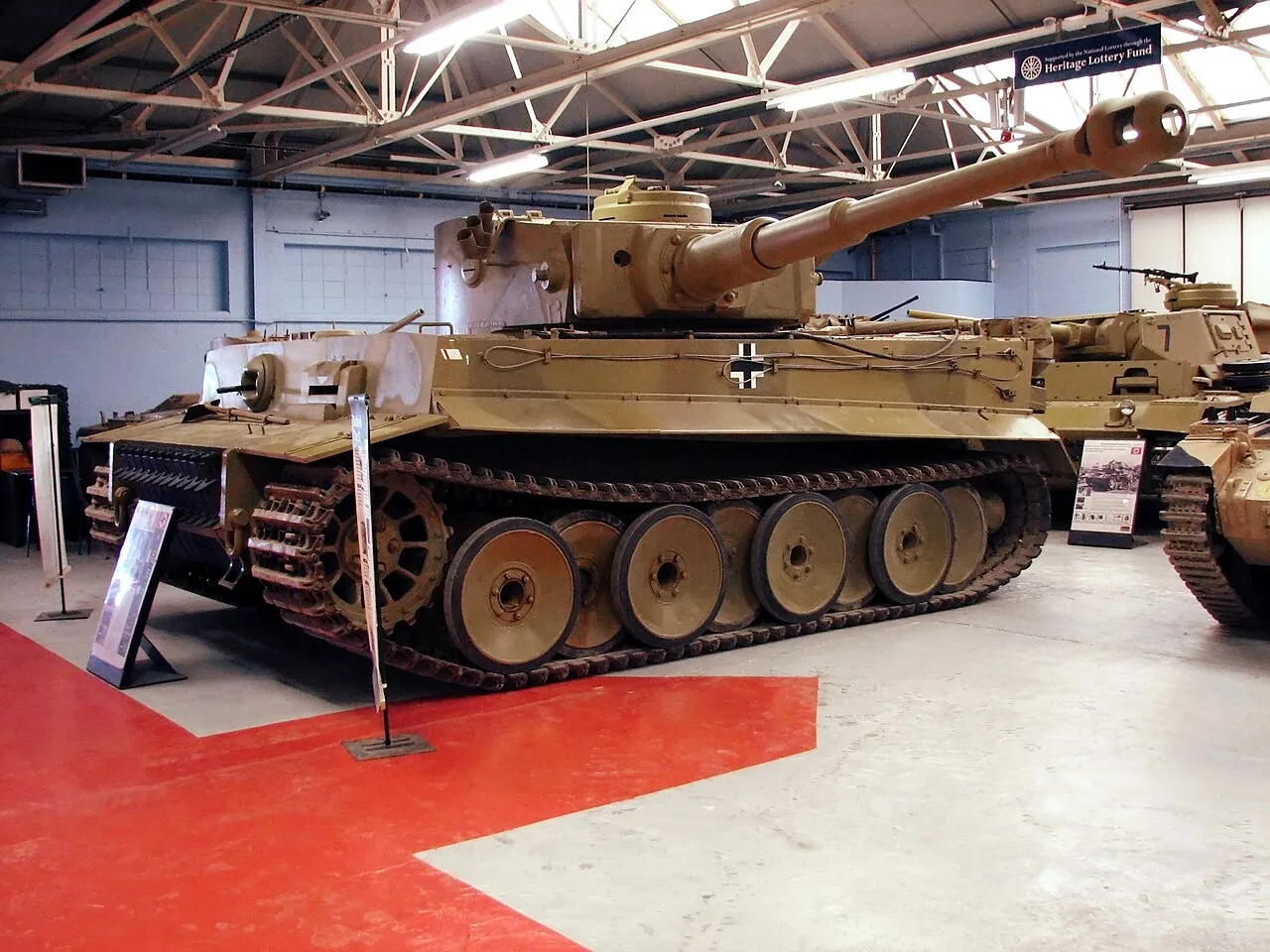
Tiger 131, captured on 24 April 1943 on Point 174 in Tunisia by the 142nd Battalion RAC and the 2nd Sherwood Foresters, was the first complete and intact Tiger I taken by the Western Allies. The Tank Museum describes it as one of just two running Tiger I tanks2 in the world.