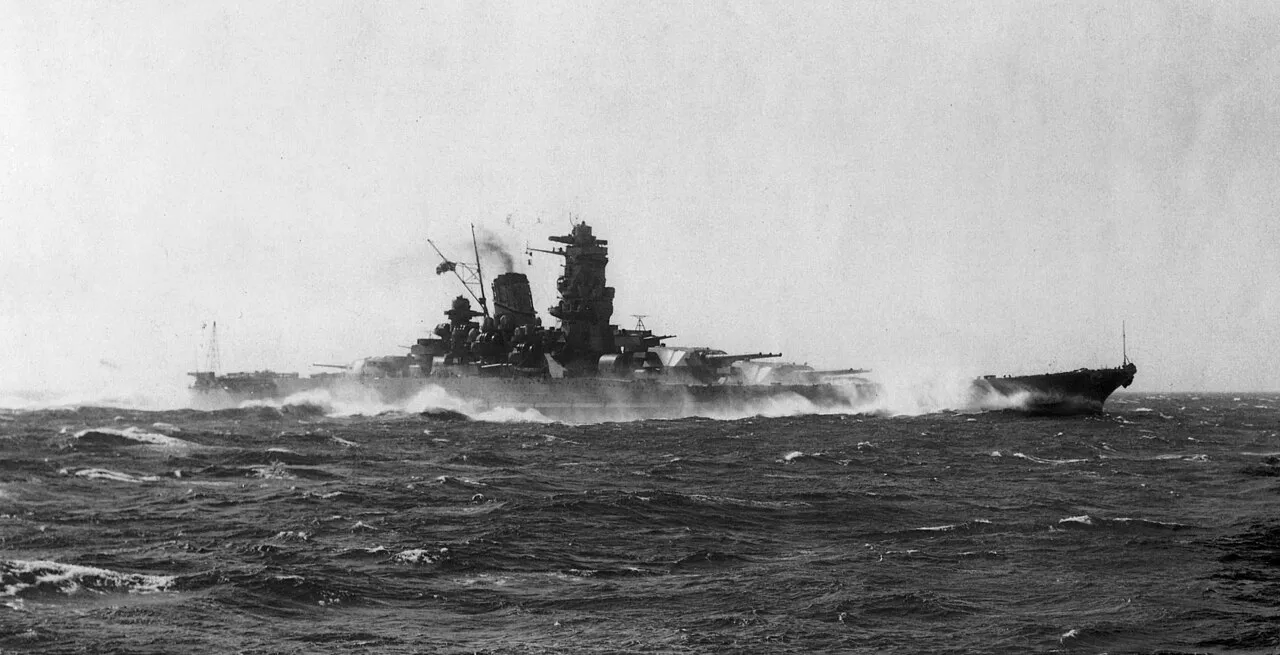
Yamato was the lead ship of her class of battleships, built for the Imperial Japanese Navy shortly before World War II. She and her sister ship Musashi were the heaviest and most powerfully armed battleships ever constructed1. Yamato carried nine 18.1-inch (460 mm) main guns, the largest ever mounted on a warship. She was first commissioned in 1941, and her final mission, Operation Ten-Go, ended in April 1945 when US aircraft sank her off Okinawa2.
The ship was named after the ancient Yamato Province, and the word Yamato was historically used as a poetic name for Japan1.
Design and construction
After withdrawing from the Washington Naval Treaty, which limited the size and power of capital ships, the Imperial Japanese Navy began the design of the Yamato class. Its planners recognized that Japan would be unable to compete with the output of US naval shipyards, so the ships were designed to engage multiple enemy battleships at the same time1. The design team of Constructor Rear Admiral Fukuda Keijii completed the final design in March 1937, for the largest class of battleships in the world, with nine 460 mm guns in three triple turrets. Each turret would weigh more than a destroyer3.
Her keel was laid down at the Kure Naval Arsenal on 4 November 19373, in a dock that had to be adapted to her hull: it was deepened by one metre, and gantry cranes able to lift up to 350 tonnes were installed. Extreme secrecy was kept throughout construction, with a canopy erected over part of the dry dock1 to screen the ship from view. The guns were officially designated 40 cm/45 Type 94 in an effort to hide their actual size, which remained a closely guarded secret until after World War II4.
Yamato was launched on 8 August 19403. She was formally commissioned at Kure on 16 December 19411, months ahead of schedule, and the same day joined Nagato and Mutsu in the 1st Battleship Division.
Specifications
Yamato displaced nearly 72,000 tons fully loaded2. During sea trials in October or November 1941 she reached her maximum possible speed of 27.4 knots1.
Each of her 46 cm guns could fire 3,200-pound (1,460 kg) shells over 26 miles (42 kilometers)2. NavWeaps calls them the most powerful guns ever installed on a battleship. It gives a rate of fire of 1.5 to 2 rounds per minute and a barrel life of about 150 to 250 rounds. Dispersion was very small, with spreads of 400 to 500 m at maximum range recorded. A total of 27 guns were produced4, and eighteen of them were lost with Yamato and Musashi.
Her secondary battery comprised twelve 155 mm guns in four triple turrets and twelve 12.7 cm guns in six twin mounts; the 155 mm turrets had been taken off the Mogami-class cruisers. Yamato was dry-docked at Kure for radar and anti-aircraft upgrades from 25 February to 18 March 1944, which raised the number of her 127 mm and 25 mm anti-aircraft guns to 24 and 1621.
Service history
On 12 February 1942 the flag of Admiral Isoroku Yamamoto, commander-in-chief of the Combined Fleet, was transferred from Nagato to Yamato. At Midway she sailed with the Main Body, which remained 600 miles behind the Carrier Striking Force3. Yamamoto exercised overall command from Yamato’s bridge, but the battleship group was too far away to take part in the engagement1.
At Truk she remained throughout the Guadalcanal campaign because of a lack of 46 cm ammunition suitable for shore bombardment1, uncharted seas around Guadalcanal and her high fuel consumption. On 11 February 1943 the Combined Fleet flag passed to her new sister ship Musashi. On 25 December 1943, at least one torpedo from the US submarine Skate hit Yamato near turret No. 3, and she took on about 3,000 tons of water3, far more than her designers had anticipated.
During the Battle of the Philippine Sea, between June 19 and June 23 1944, Yamato escorted forces of Ozawa’s Mobile Fleet; her only significant contribution was mistakenly opening fire on returning Japanese aircraft. In the Battle of the Sibuyan Sea in October 1944, aircraft from USS Essex struck her with two armor-piercing bombs1, but she remained battleworthy.
Yamato is known to have fired at enemy ships on only one occasion4, at the Battle off Samar in October 1944, with rounds possibly hitting USS Gambier Bay. Other accounts credit her with sinking or helping to sink1 the escort carrier Gambier Bay and the destroyers Johnston and Hoel.
Fate
Allied forces invaded Okinawa on 1 April, and Yamato was dispatched on a one-way mission to Okinawa in April 1945. Under Operation Ten-Go, Yamato and nine escorts were to sail to Okinawa and attack the Allied forces there; Yamato would then be beached to act as an unsinkable gun emplacement and fight until destroyed. The Allies had intercepted and decoded1 the Japanese radio transmissions and learned the particulars of the operation.
On 7 April 1945 the first wave of 280 American aircraft reached the force. From the first attack at 12:37 to the explosion at 14:23, Yamato was hit by at least 11 torpedoes and 6 bombs1. At 14:23, her No. 1 magazine exploded and sent up a cloud of smoke seen 100 miles away. According to the record of movement by Bob Hackett and Sander Kingsepp (2000–2016), Vice Admiral Ito, Captain Aruga and 3,055 of 3,332 crewmen were lost, 276 men were rescued, and the Americans lost 10 aircraft and 12 crewmen. She was removed from the Navy List on 31 August 19453.
A Japanese team in the submersible Pisces II located Yamato on 1 August 1985, 1,410 feet deep in the East China Sea3. The team found the wreck in two pieces, with the forward section on its starboard side and the aft section bottom up. In 2005 the Yamato Museum opened near the site of the former Kure shipyards, with a 26.3-metre model of Yamato at 1:10 scale1 as its centerpiece.
Sister ships and similar ships
- Musashi, her sister ship of the Yamato class: she took over as flagship of the Combined Fleet on 11 February 19433 and sank in the Battle of the Sibuyan Sea after being hit with 17 bombs and 19 torpedoes1.
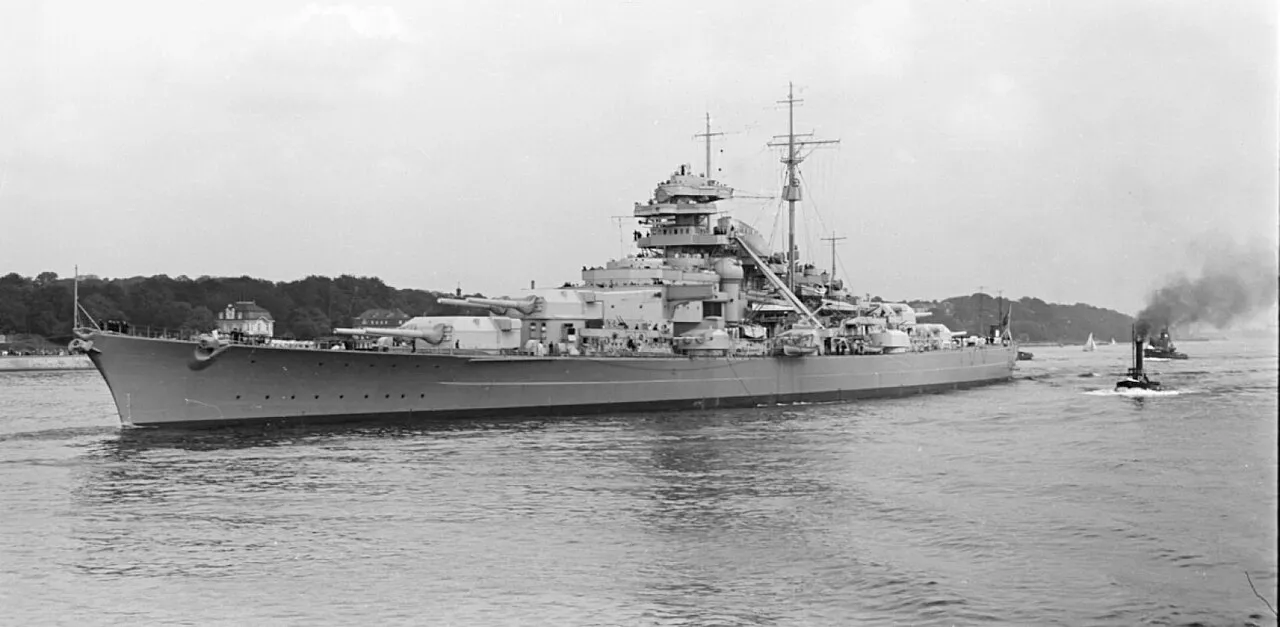
- German battleship Bismarck: a main battery of eight 38 cm guns in four twin turrets5, against Yamato’s nine 46 cm guns in three triple turrets3.