Contents
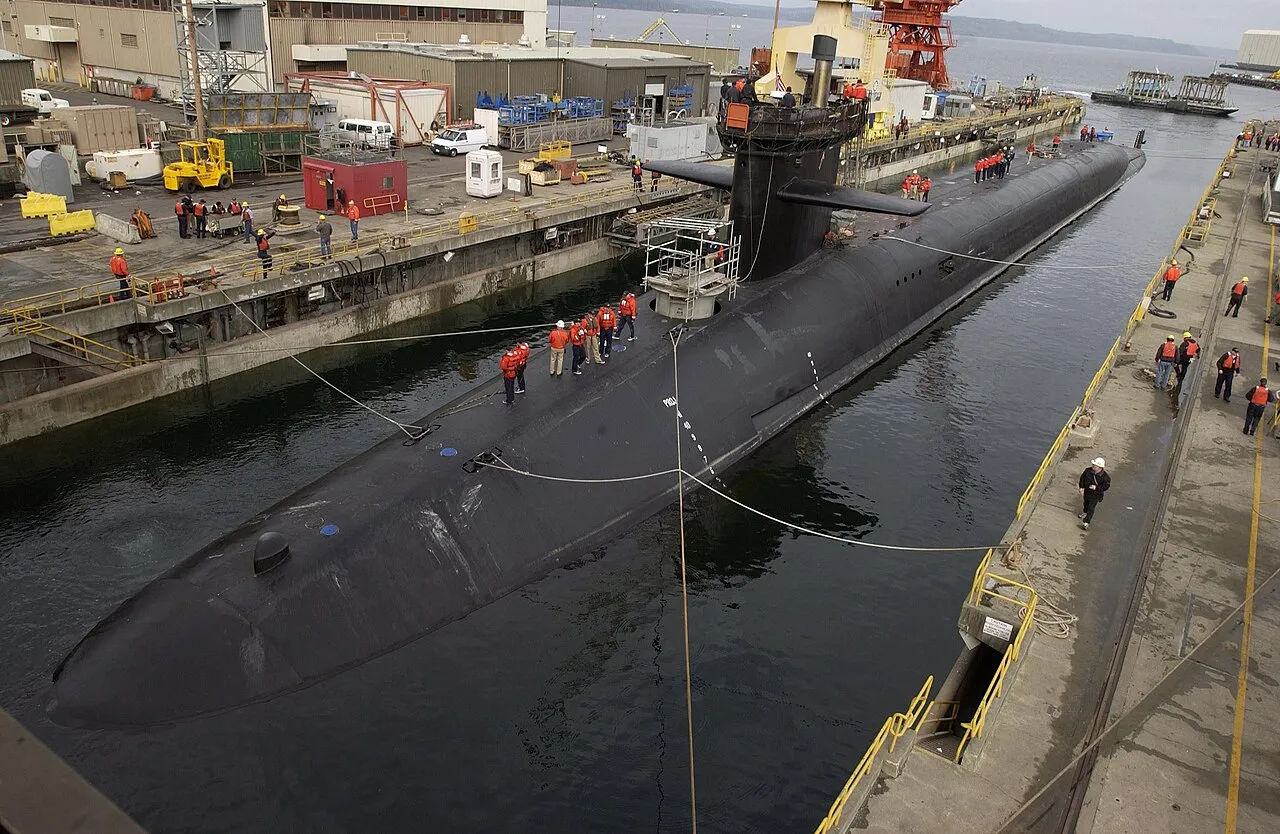
The Ohio class is the US Navy’s class of nuclear-powered submarines, made up of 14 ballistic missile submarines (SSBNs) and 4 cruise missile submarines (SSGNs). The Navy procured 18 of the boats between FY1974 and FY1991 for the US strategic nuclear deterrent force, and they are commonly called Trident submarines because they carry Trident submarine-launched ballistic missiles. The first entered service in 1981, the 18th in 19972. With a submerged displacement of 18,750 tons3, the design is more than twice the size of earlier US SSBNs, and the boats are the largest submarines ever built for the U.S. Navy1.
Design and development
The STRAT-X study in 1967 recognized that the SSBN force was aging and would require replacement. On 14 September 1971 the Deputy Secretary of Defense approved a decision paper that authorized both a new, large, higher-speed submarine and the Trident (C4) missile system. The Navy awarded General Dynamics’ Electric Boat Division the contract for the first Trident submarine on 25 July 19744.
The program was first projected at 10 submarines based at Bangor, Washington; by 1981 it had been modified to include 15 boats, and at least 20 were planned by 1985. In 1991 Congress directed the termination of the program with the 18th boat4, citing anticipated force limits under the START I arms control agreement.
The boats were built from hull sections 42 ft (13 m) in diameter1, produced at Electric Boat’s Quonset Point facility in Rhode Island and assembled at its shipyard in Groton, Connecticut. The pressure hull is made of HY-80 steel4, supported by circular frames and closed by hemispherical heads at both ends. For extended deterrent patrols the class has three large-diameter logistics hatches5 through which sailors can rapidly transfer supply pallets, equipment replacement modules and machinery components. The boats were originally designed for 30-year service lives but were later certified for 42-year service lives3, with two operating periods of approximately 19 years separated by a midlife nuclear refueling overhaul of approximately four years.
Specifications
An Ohio-class boat is 560 feet (170.7 m) long with a beam of 42 feet3 (12.8 m). The Federation of American Scientists gives 16,764 tons surfaced and 18,750 tons submerged. Power comes from one S8G nuclear reactor4 with two geared steam turbines on one shaft, rated at 60,000 hp.
The official speed is 20+ knots; the same source puts the actual submerged speed at 25 knots and gives a maximum depth of over 800 feet. The crew numbers 15 officers and 140 enlisted4.
Each SSBN has two crews, Blue and Gold, which take turns manning the boat and taking it on patrol. According to the Navy, the submarines spend on average 77 days at sea followed by 35 days in port for maintenance, and the design lets them operate for 15 or more years between major overhauls5.
Armament and sensors
Each of the 14 SSBNs originally carried up to 24 SLBMs with multiple, independently targeted warheads. Under the New START treaty, four of its missile tubes were permanently deactivated on each boat, which as of 2025 can each carry 20 SLBMs3. The missile is the Trident II D5, which gives increased range and accuracy5 over the Trident I C4, which the Navy listed as out of service.
Lockheed Martin, the Navy’s strategic missile prime contractor, says the D5 was first deployed in 19906 and serves aboard US Ohio-class and UK Vanguard-class submarines. The first eight boats, SSBNs 726 through 7332, were originally armed with Trident I (C4) missiles, and the final 10 with the larger and more powerful Trident II (D5). Starting with Alaska in 2000, the Navy converted the remaining C4-armed boats to carry the D5, a task completed in mid-20081.
The boats also have four torpedo tubes for Mark 48 torpedoes1. Their sensors include the BQQ-6 bow-mounted sonar and the BQS-13 active sonar4.
Variants
The 1994 Nuclear Posture Review recommended a force of 14 Tridents rather than 18, which prompted interest in converting the first four boats, SSBNs 726 through 729, into non-strategic submarines called SSGNs. As converted, they can carry up to 154 Tomahawk cruise missiles and 66 Navy SEAL special operations personnel. Tubes 1 and 2 were altered to serve as lockout chambers for those personnel, and tubes 3 through 24 carry 7 Tomahawks each2.
The Navy estimated the total cost of the four conversions at about $4.0 billion, or about $1 billion per boat. Puget Sound Naval Shipyard at Bremerton converted SSBNs 726 and 727, and Norfolk Naval Shipyard SSBNs 728 and 729. Initial Operational Capability for the SSGNs was declared on 1 November 20072.
Ships in class
General Dynamics’ Electric Boat Division of Groton, Connecticut, and Quonset Point, Rhode Island, is the designer and builder of all 18 Tridents2. The lead boat, USS Ohio (SSGN-726), was commissioned on 11 November 19811. The commissioning of USS Louisiana (SSBN 743) at Kings Bay on 6 September 19974 completed the fleet of 18.
The four SSGNs are Ohio, Michigan, Florida and Georgia, the four oldest boats. The Navy’s list of SSBNs runs from USS Henry M. Jackson (SSBN 730) to USS Louisiana (SSBN 743)5, and every boat except Henry M. Jackson is named for a US state1. As of 20253, eight of the 14 SSBNs are homeported at Bangor, Washington, and the other six at Kings Bay, Georgia.
Service history
The Ohio-class SSBNs are part of the United States’ nuclear-deterrent triad, along with Air Force strategic bombers and intercontinental ballistic missiles. In 2011 the boats carried out 28 deterrent patrols, and from January to June 2014 USS Pennsylvania made a 140-day-long patrol1.
USS Ohio, the first boat converted, reportedly began its first operational deployment as an SSGN in October 2007. In 2008 the Congressional Research Service reported that SSBNs 726 and 727, though homeported at Bangor, were operated out of the U.S. territory of Guam in the Western Pacific. It expected the SSGNs to be decommissioned in the late 2020s2.
The Columbia class is to build 12 new SSBNs to replace the 14 Ohio-class boats. The first Ohio-class SSBN to retire, SSBN-730, reaches the end of its 42-year service life in 2027, and the remaining 13 follow at roughly one ship per year, the 14th in 2040. In its report updated December 4, 2025, the Congressional Research Service said the Navy is planning to extend the service lives of up to five Ohio-class SSBNs3 to hedge against potential delays in Columbia-class deliveries.
Similar classes
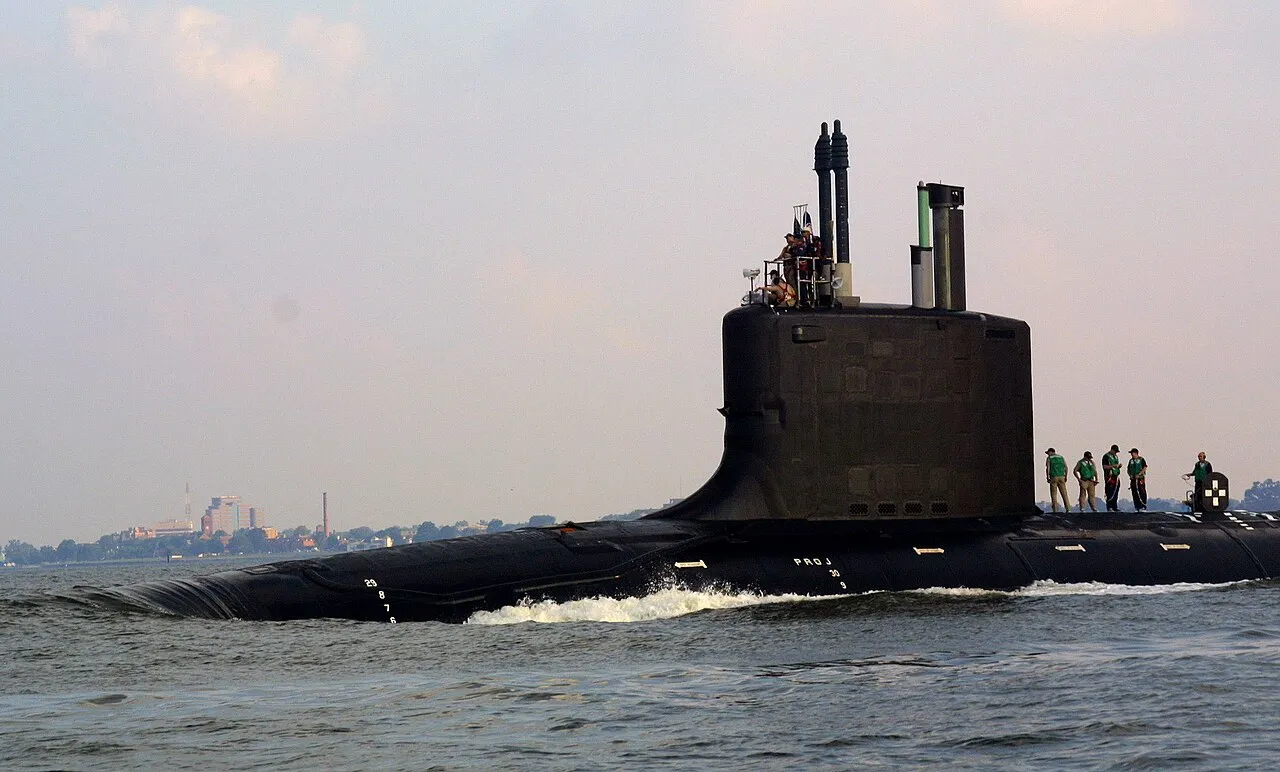
The US Navy’s own successor, the Columbia class, has 16 SLBM tubes against 24 on the Ohio class, yet is larger in submerged displacement, with a beam of 43 feet against 42 feet3. The Royal Navy’s Vanguard-class SSBNs carry the same Trident II D5 missile, according to Lockheed Martin6. The Soviet and Russian Navy’s Typhoon class was larger still, at 48,000 tons, with its last boat retired in 2023. The US Navy’s Virginia class, an attack submarine, is to take over the SSGNs’ capabilities1 in its Virginia Payload Module version.