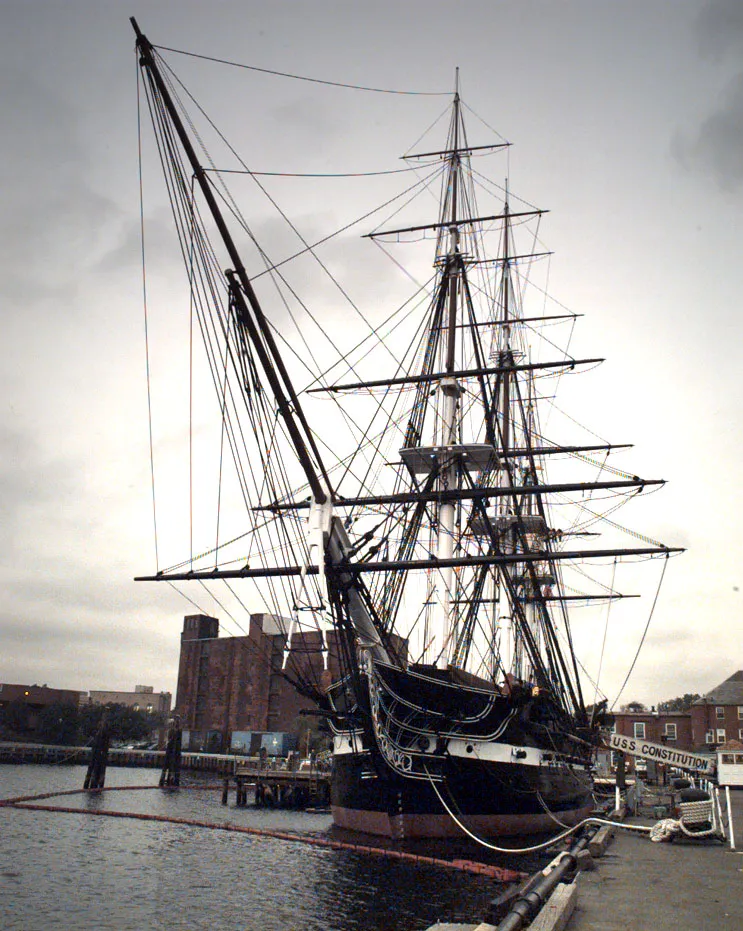
USS Constitution is a frigate of the United States Navy, launched on October 21, 1797 from Edmund Hartt’s shipyard in Boston. She was one of the six frigates that began the new United States Navy, and the Navy’s history command calls her the sole survivor of the original U.S. Navy2. The National Park Service describes her as the oldest commissioned warship afloat in the world. She is remembered for capturing 33 vessels in 57 years of active service and for her three War of 1812 victories against the Royal Navy, and in that war she gained the name “Old Ironsides”3. She became “America’s Ship of State” in October 20091.
Design and construction
After 1785 the United States had no Continental Navy, and its merchant vessels sailed unprotected. Barbary corsairs of North Africa captured U.S. vessels and crews and held them for ransom2. In 1794, Congress authorized the construction of six warships3 to become a new navy.
Joshua Humphreys, the principal designer, decided that the ships had to be the strongest, fastest, and most heavily armed frigates of the era2. His design was deep, long on keel, narrow of beam and mounted very heavy guns, and it called for diagonal riders to restrict hogging and sagging. Humphreys knew the young United States could not match the size of European navies, so the frigates were meant to overpower any other frigate while escaping from a ship of the line4.
Her keel was laid down on 1 November 1794 at Hartt’s shipyard, under the supervision of Captain Samuel Nicholson and master shipwright Colonel George Claghorn. The southern live oak for her frame was cut from Gascoigne Bluff near St. Simons Island, Georgia, and enslaved workers were used to harvest the oak. A peace accord with Algiers in March 1796 halted the work, until Congress agreed to keep funding the three ships nearest to completion4: United States, Constellation and Constitution. Her hull has three layers, white oak planking over dense live oak framing, more than 22 inches thick at the waterline2. Her final construction cost was $302,718.841.
Specifications
Constitution measures 305 feet (93 meters) overall, from bowsprit to spanker boom, and 207 feet (63.1 meters) from billet head to taffrail. Her beam is 43.5 feet (13.3 meters). The USS Constitution Museum gives a displacement of 1,900 tons today and approximately 2,200 loaded in 18125. Fully loaded in 1812 she drew 24 feet aft (7.3 meters). Her main mast stands 172 feet1 above the spar deck.
She is a sailing ship: in 1812 she carried 48 sails, over 44,000 square feet of canvas, and her speed was 13+ knots1. She was rated as a 44-gun frigate. In the War of 1812 her gun deck carried thirty 24-pound long guns with a range of 1,200 yards, and her spar deck twenty-four 32-pound carronades5 with a range of 400 yards, plus one 18-pound bow chaser. Ships of her era had no permanent battery, and she often carried more than 50 guns. All her guns have been replicas since her 1927–1931 restoration4.
Her crew in 1812 numbered over 450 Sailors and Marines1. The museum gives today’s crew as 3 officers and approximately 80 enlisted5 U.S. Navy sailors.
Service history
Her career began on July 22, 1798, when she sailed to the Caribbean to protect American merchant vessels from French privateers in the Quasi-War. Under Captain Silas Talbot, supplies were transferred from a stores ship at sea, which kept her at sea 347 days out of 3662 in 1799.
Under Commodore Edward Preble she sailed to the Mediterranean in 1803 for the war with Tripoli. Preble’s squadron bombarded Tripoli in August and September 1804, and on June 3, 18052 the draft peace treaty with Tripoli was signed in her great cabin.
On August 19, 1812, in the North Atlantic, she met HMS Guerriere, and thirty-five minutes after the Americans opened fire the British frigate surrendered. It was the first frigate-to-frigate victory of the U.S. Navy over the Royal Navy1. A sailor who saw British cannon balls fall harmlessly off her oak hull purportedly shouted2 that her sides were made of iron. Under William Bainbridge she met HMS Java on 29 December, and Java was far too damaged to retain as a prize and was burned. She fought the small British ships Cyane and Levant together on 20 February. She emerged from the war undefeated4, while her sister ships Chesapeake and President were captured.
In the 1820s and 1830s she regularly sailed to the Mediterranean to protect American commerce. In 1830 a newspaper claimed in error that the Navy meant to scrap her; the poem “Old Ironsides” by Oliver Wendell Holmes followed two days later4 and stirred public efforts to save her. In 1844 she began a two-year voyage around the world to over 25 foreign ports. During the Civil War she was a stationary training ship for the United States Naval Academy2, moved with it to Newport, Rhode Island.
Fate
Repairs kept her sailing until 1881. She then became a receiving ship at the Portsmouth Navy Yard, with a large barn built over her upper deck. In 1897, just before she turned 100, she returned to Boston for a citywide celebration. The 1927–1931 restoration replaced approximately 85% of the ship. American schoolchildren raised $154,000 in a “pennies campaign” toward it, and on the National Cruise of 1931–1934 a minesweeper towed her to 76 ports2, where she drew over 4.6 million visitors.
Since her return to Boston in 1934 she has left her homeport only once. After the 1992–1996 restoration, she sailed under her own power on July 21, 1997, for the first time in 116 years, and again on August 19, 20121. She went into dry dock in May 20154 for the 2015-2017 restoration2.
In 2017 the Navy’s history command gave her homeport as the Charlestown Navy Yard1 in Boston National Historical Park, where the Navy operates her as a partner to the National Parks of Boston, and naval officers and crew still serve aboard. The Naval History and Heritage Command, Detachment Boston, is responsible for her maintenance, repair, and restoration. She occasionally sails through Boston Harbor for anniversaries, with the assistance of tugboats, and her crew fires a cannon salute near Castle Island. The USS Constitution Museum, established in 19723, stands across the pier in Building 22.
Sister ships and similar ships
Congress authorized six frigates in 17943, and Humphreys designed them to be larger and more heavily armed and built than standard frigates of the period. United States was one of the three ships whose construction continued after 1796; she was later captured by Confederate forces at the Gosport Shipyard, leaving Constitution the last of the original six. Constellation was the other of the three ships nearest to completion in 1796. Chesapeake and President were captured in 1813 and 1815, while Constitution ended the war undefeated, and Congress was found unfit for repair4 in 1834 and broken up in 1835.
Another preserved sailing warship is HMS Victory, launched on 7 May 1765; Nelson’s flagship carried 104 guns against Constitution’s rated 44, and she rests in drydock in Portsmouth Historic Dockyard6 rather than afloat.