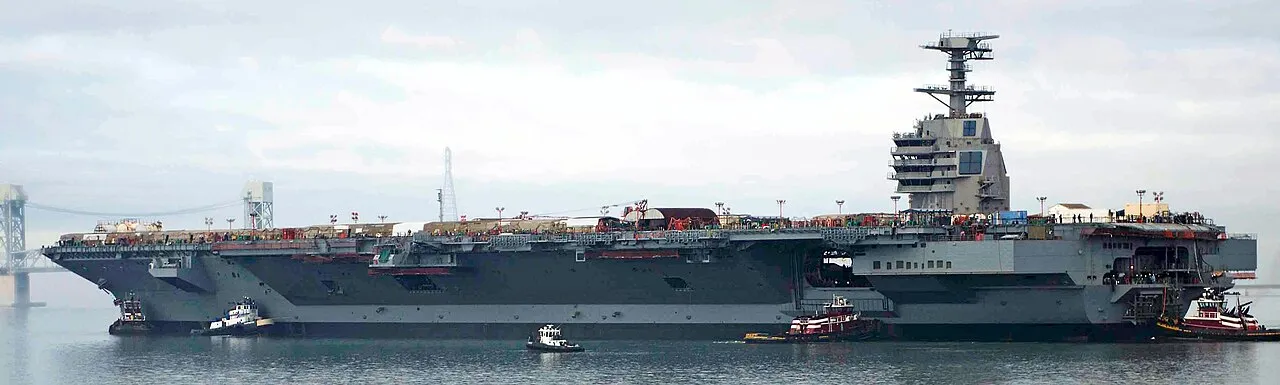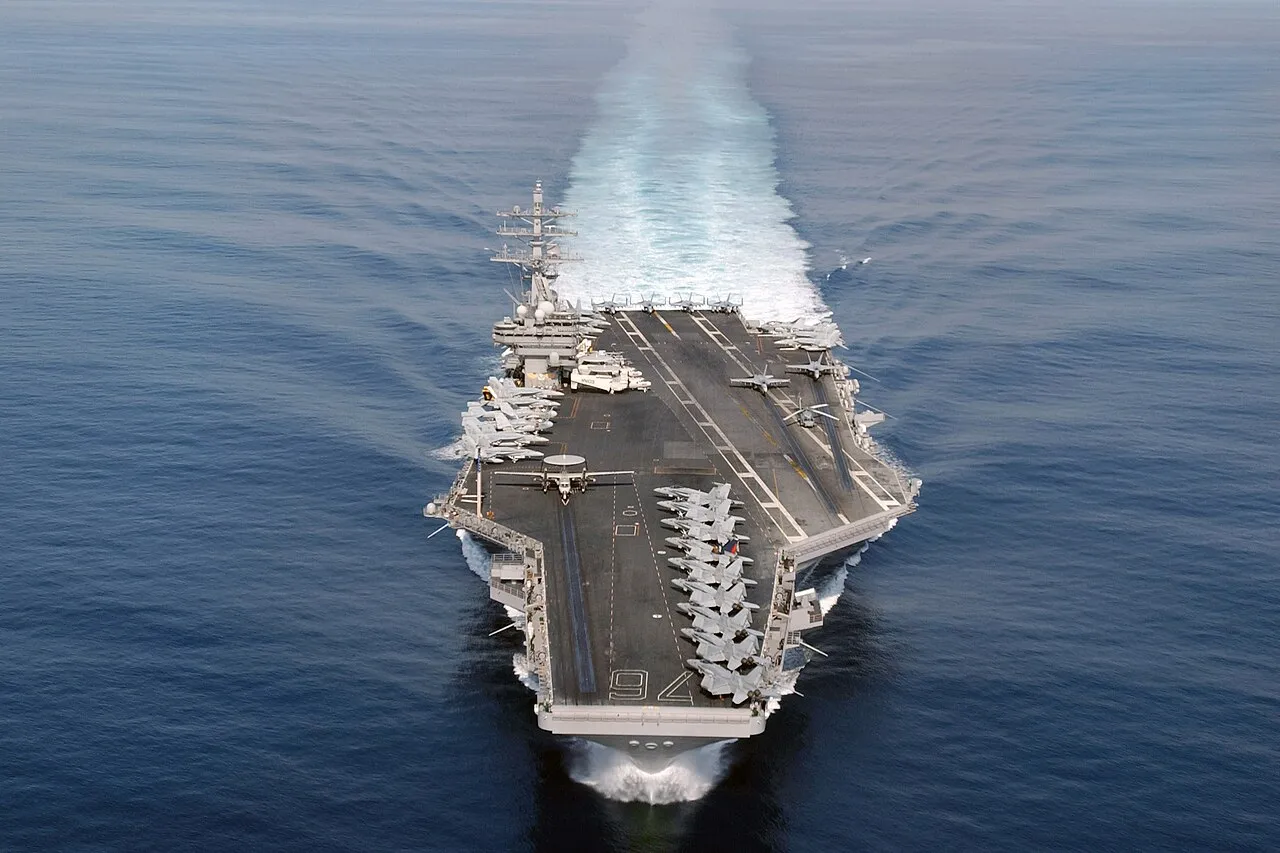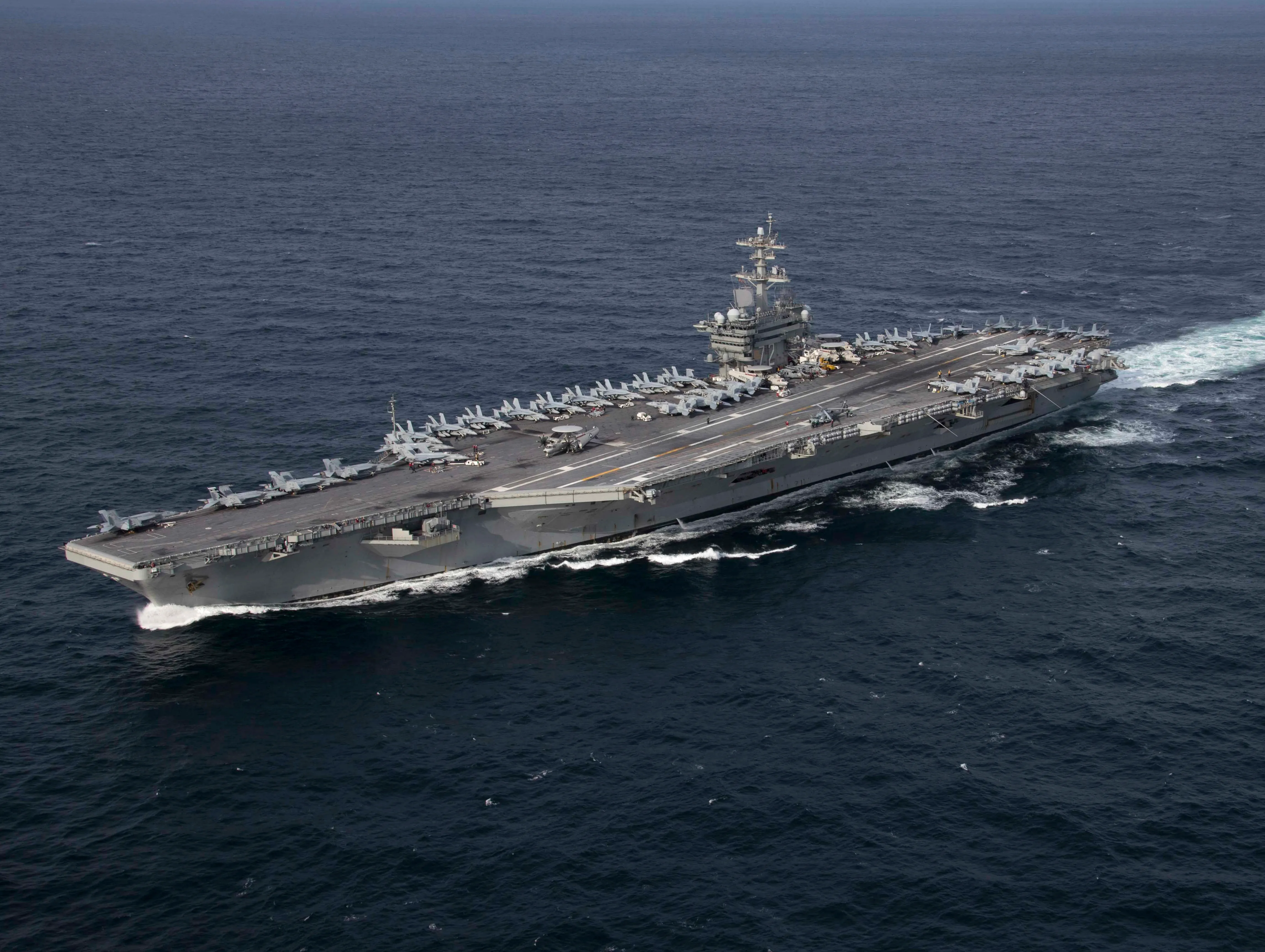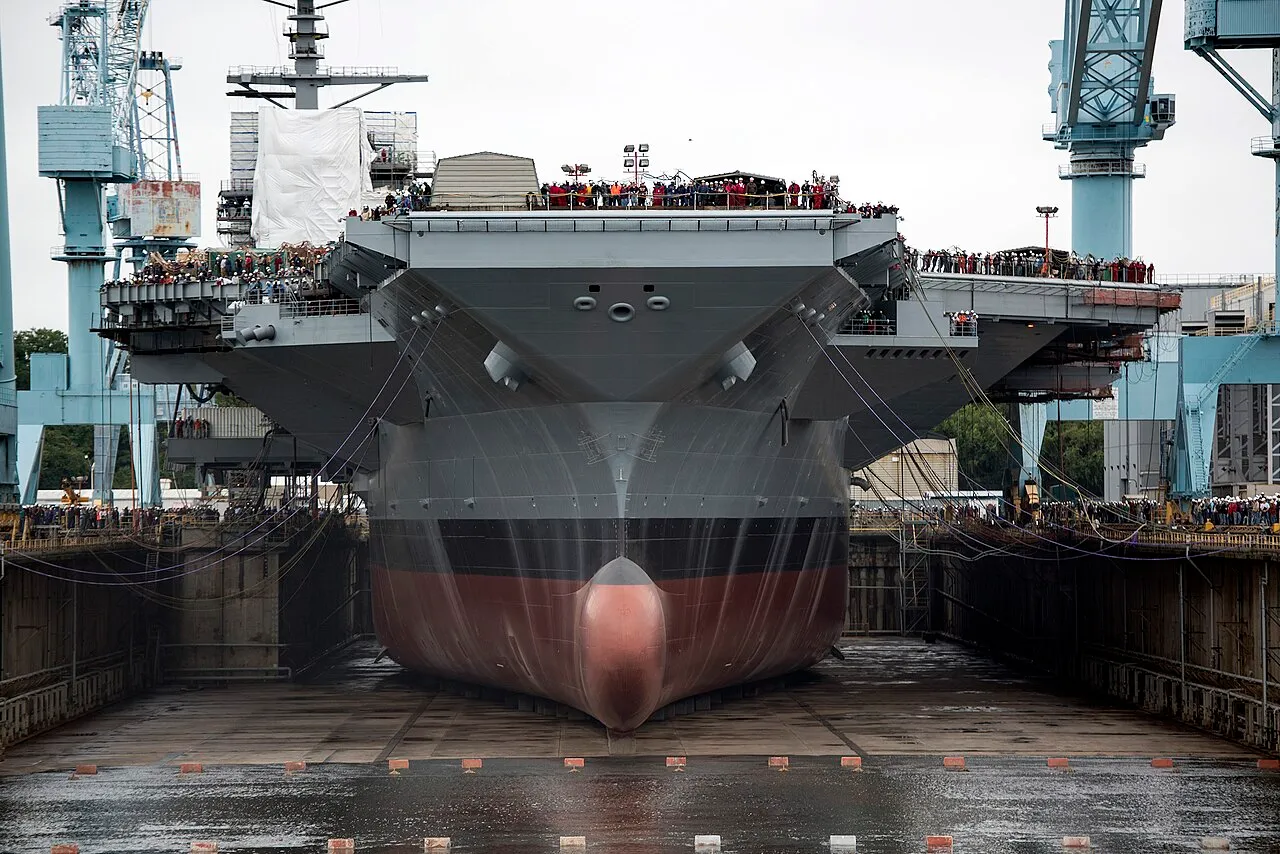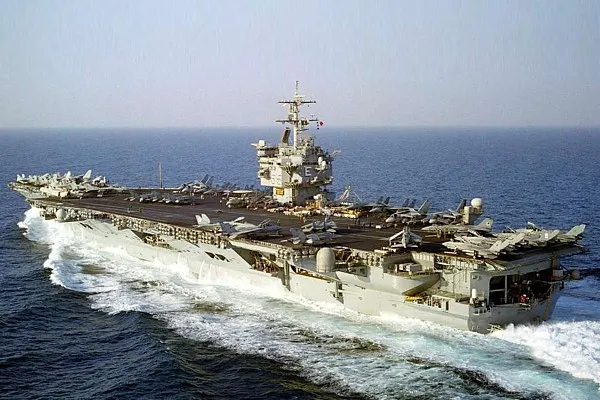
USS Enterprise (CVN-65) was a US Navy aircraft carrier that her builder calls the world’s first nuclear-powered aircraft carrier1. Nicknamed Big E, she was commissioned on 25 November 19612 and served in crises and conflicts from the Cuban Missile Crisis and the Vietnam War to Operation Iraqi Freedom. She was deactivated in December 2012 and, once her reactors had been defueled, decommissioned in February 20173.
Design and construction
The US Congress authorized construction in 1954, and the keel was laid at Newport News Shipbuilding and Drydock Company on 4 February 1958. She was launched on 24 September 19604, sponsored by the wife of William B. Franke, then Secretary of the Navy. Her hull design is a modification of the Forrestal-class carriers2.
Designing the ship on paper took approximately 900 shipyard engineers and designers, and more than 800 companies supplied the materials, among them 60,923 t of steel and 1,507 t of aluminium. Enterprise was meant to be the first of six ships, but the other five were dropped due to escalating construction costs2. Because of the huge cost of her construction, she was launched and commissioned without the planned RIM-2 Terrier missile launchers4.
She was designed for a service life of 25 years, which was lengthened through timely maintenance and upkeep. Her square island first carried phased-array radars and electronic warfare systems, which were replaced in 1980. In a refit between January 1979 and 19822, the island was rebuilt and new radars and a mast were fitted.
Specifications
Enterprise was 1,123 ft long, considered the longest carrier in the US Navy, with a waterline beam of 132.8 ft, a draught of 39 ft and a displacement of 94,781 t. The flight deck covered 4.47 acres and was 252 ft wide, and the hangar bay five acres2.
Power came from eight Westinghouse second-generation A2W nuclear reactors, and four Westinghouse steam turbines produced 280,000 hp for four propellers with five blades each. She had four rudders of 35 t each. On her first sea trials her speed exceeded 40 miles an hour2.
For flight operations she had four aircraft elevators, four steam-powered catapults and four arresting wires, and she could launch and recover aircraft at the same time. Depending on the mission she could embark more than 90 aircraft, with 66 at any given time. Her air wing comprised approximately 43 F/A-18 Hornet strike fighters2 alongside EA-6B Prowler, E-2C Hawkeye and S-3B Viking aircraft and SH-60F Seahawk helicopters.
The carrier initially had little defensive armament. Late in 1967 she was fitted with a prototype Basic Point Defense Missile System4, two eight-round box launchers for Sea Sparrow missiles. In her final form she was armed with three Mk 29 NATO Sea Sparrow launchers, three 20 mm Phalanx CIWS and two RAM systems, and her radars included an SPS-48E 3D air search radar and an SPS-49(v)5 long-range air search radar2.
Service history
Enterprise made her maiden voyage on 12 January 1962, and on 20 February 1962 she was a tracking and measuring station for the flight of Friendship 7, John Glenn’s orbital spaceflight. In October 1962 she was one of five Second Fleet carriers in the blockade of Cuba. In 1964 she sailed with the cruisers Long Beach and Bainbridge in Operation Sea Orbit, the world’s first nuclear-powered task force4.
Transferred to the Seventh Fleet in November 1965, she became the first nuclear-powered ship to engage in combat on 2 December 1965, launching aircraft against the Viet Cong near Biên Hòa City. The next day she set a record of 165 strike sorties in a single day. On 14 January 1969 a Zuni rocket on a parked F-4 Phantom exploded after an aircraft start unit overheated it, and the fires that followed killed 27 sailors, injured 314 more and destroyed 15 aircraft4.
During the evacuation of Saigon in Operation Frequent Wind, aircraft from Enterprise flew 95 sorties, and her squadrons VF-1 and VF-2 made the first combat deployment of the F-14 Tomcat. In April 1988, during Operation Praying Mantis, aircraft of her air wing bombed two Iranian frigates, helping to sink one. From October 1990 she went through a refueling and complex overhaul at Newport News and returned to sea on 27 September 19944.
Her later operations included Desert Fox, Southern Watch, Enduring Freedom and Iraqi Freedom3. She was beginning her voyage home from the Persian Gulf when the September 11 attacks happened and, without orders, returned to the waters off Southwest Asia4. Northrop Grumman received a $453.3m maintenance contract in April 2008 and redelivered the ship in April 2010, at a reported cost of $662m2, her last scheduled drydocking.
Her final deployment began on 11 March 2012. She came home to Norfolk for the last time on 4 November 2012 after a 238-day deployment of nearly 81,000 miles in which her aircraft flew more than 2,000 sorties in support of Operation Enduring Freedom. At her inactivation ceremony, Secretary of the Navy Ray Mabus announced that the next Gerald R. Ford-class carrier, CVN-80, would be named Enterprise4.
Fate
After her deactivation the ship was towed to Newport News Shipyard in June 20132. Newport News Shipbuilding completed the inactivation in 20181, work that had begun in 2013. The final reactor was defueled in December 2016, and on 3 February 2017 she was decommissioned and struck from the Naval Vessel Register. Over 35,000 pounds of steel4 from the old carrier has been used in CVN-80.
The hull stayed at Newport News Shipbuilding while the Navy planned its disposal. In a contract announcement on 30 May 2025, the Defense Department gave NorthStar Maritime Dismantlement Services a $536.7 million firm-fixed-price contract to dismantle, recycle and dispose of the ship. The work is to be done in Mobile, Alabama, and completed by November 2029. Before this 2025 contract, the Navy scrapped its nuclear-powered ships itself, in recent years at Puget Sound Naval Shipyard; the Navy says the commercial route saves an estimated $1 billion3.
Sister ships and similar ships
Enterprise had no sister ships: she was the only ship of her class1.
- Nimitz-class aircraft carrier: the class that succeeded Enterprise2; each of its ships has two nuclear reactors1, against eight in Enterprise.
- USS Gerald R. Ford: the Ford-class carrier that replaced Enterprise, commissioned in July 20172; her class launches aircraft with software-controlled electromagnetic catapults1 instead of steam.
- USS Enterprise (CVN-80): the future Gerald R. Ford-class carrier that has adopted the name4.
- USS Long Beach: a cruiser, not a carrier, and with Enterprise one of only two ships to carry the SCANFAR phased-array radar4.