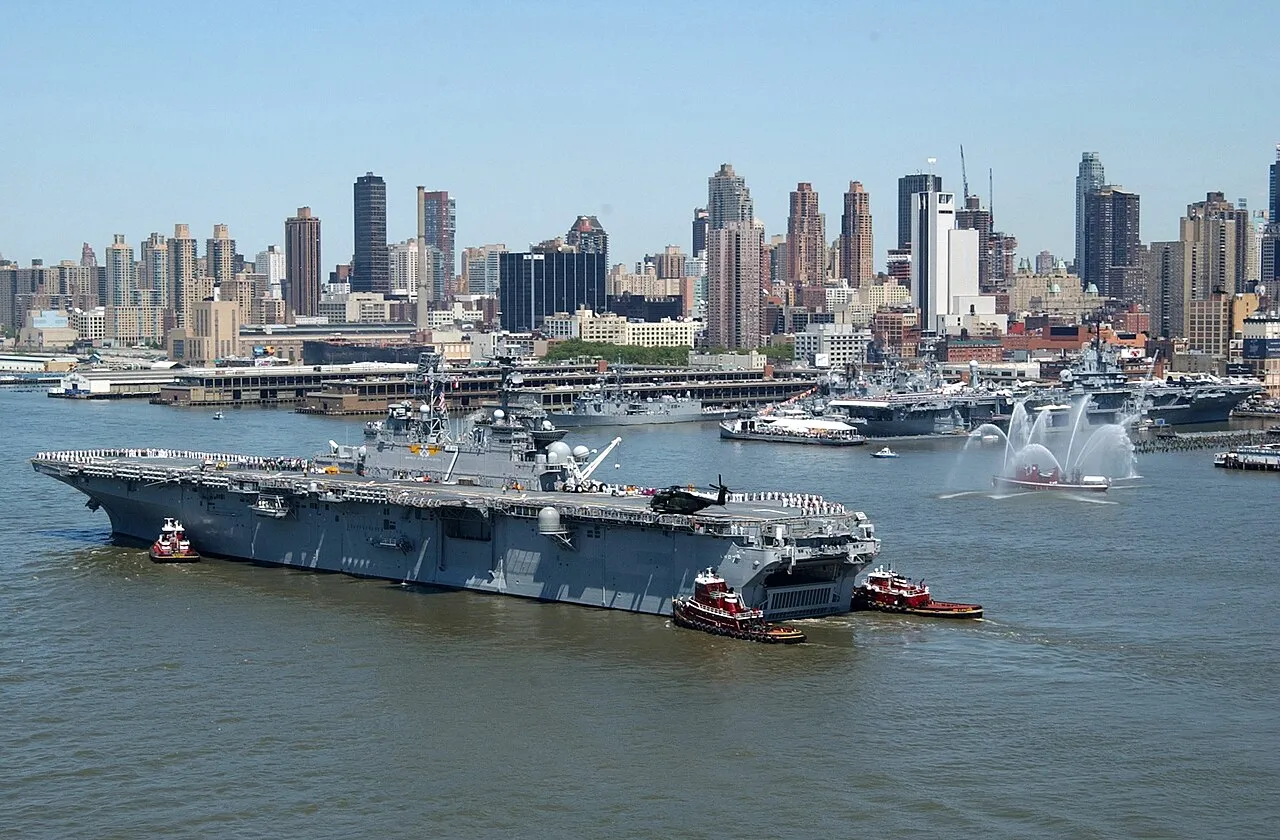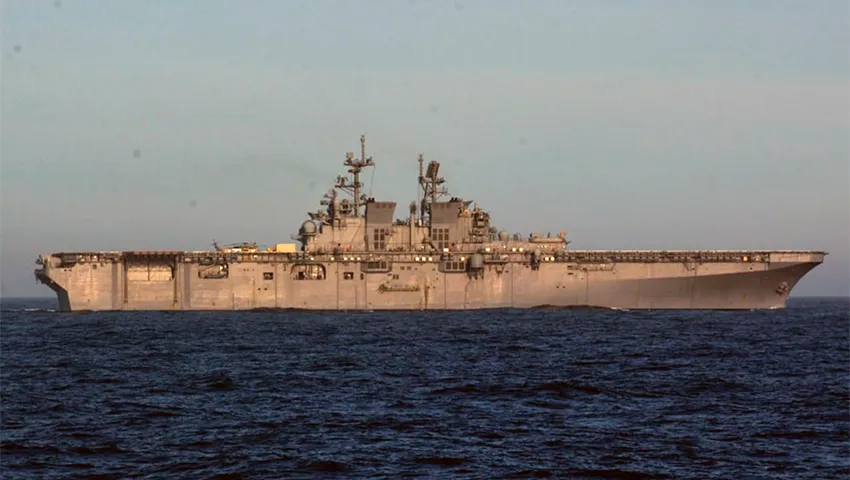
USS Tripoli (LHA-7) is the second America-class amphibious assault ship1 built for the United States Navy. The Navy commissioned her on July 15, 20202, administratively, after it canceled the traditional public ceremony because of restrictions on large public gatherings. Tripoli has a larger hangar deck, expanded aircraft maintenance facilities and more aviation fuel3, and she is geared to operate the F-35 with other future Marine Corps aircraft. On her maiden deployment in 2022 she took on 20 F-35Bs at one point4 in a test of the “lightning carrier” concept.
She is the third Navy ship to be named Tripoli. The name honors the U.S. Marines and approximately 370 soldiers from 11 other nationalities2 who captured Derna, Libya, in the 1805 Battle of Derna, which the Marines’ Hymn recalls with the line “to the shores of Tripoli.”
Design and construction
Like the lead ship America (LHA-6), Tripoli was built to give the fleet a more aviation centric platform. The Navy listed an enlarged hangar deck, expanded aviation maintenance facilities, much more stowage for parts and support equipment, and more aviation fuel. At the keel laying the Navy’s amphibious warfare program manager called it a design that replaces the Tarawa class5 of amphibious assault ships.
The class is based on USS Makin Island, the last Wasp-class ship, and approximately 45 percent of the “Flight 0” design6 comes from her, but with the well deck omitted to leave more room for aircraft, spare parts, weapons and fuel. In its place the ships have an extended hangar deck with two wide and high bay areas, each with an overhead crane for aircraft maintenance. The design also includes a reconfigurable command and control centre, a hospital7 and aviation support areas.
Northrop Grumman received a $175m advance procurement contract7 for LHA-7 in June 2010. Fabrication began in July 2013, and the keel laying and authentication ceremony was held at the Huntington Ingalls Industries shipyard in Pascagoula, Mississippi, on June 20, 20145, with ship sponsor Lynne Mabus as one of the keel authenticators.
On April 9, 2017, the hull was moved from land into the dry dock, a translation that took 247 jacking and pallet cars and 19 hours of continuous work. The dry dock was then flooded and Tripoli floated off on May 1, 2017; at that point the Navy planned delivery for late 20188. She was christened on 16 September 20174. The Navy accepted delivery from HII’s Ingalls Shipbuilding division on February 28, 20209.
During the COVID-19 pandemic, Navy officials said on 17 April 2020 that at least nine sailors assigned to the ship had tested positive while she was docked in Pascagoula. The public commissioning ceremony planned for NAS Pensacola was cancelled4, and the ship was commissioned in Pascagoula, where she had been built.
Specifications
The Navy gives Tripoli a length of 844 feet, or about 257 m, and a displacement of approximately 44,971 long tons9, about 45,700 tonnes. The beam of the class is 32.3m7.
The propulsion plant combines gas turbines, zonal electrical distribution and electric auxiliary systems first installed on USS Makin Island (LHD-8). There are two LM2500+ gas turbines and two 5,000hp auxiliary propulsion motors7; the propellers are driven either by the turbines or by the electric motors, which lets the ship run in a more fuel-efficient mode across its speed range. The Navy states a speed of over 20 knots9.
A ship of the class can accommodate 1,204 crew and 1,871 troops. Its air group can include 12 MV-22B Ospreys, six F-35Bs, four AH-1Zs, four CH-53Ks and three UH-1Ys, though the exact mix varies by mission. For self-defense the ships carry two Rolling Airframe Missile launchers and two Evolved Sea Sparrow launchers, two 20mm Phalanx close-in weapon systems, seven twin .50-calibre machine guns, and Raytheon’s ship self-defense system7, which integrates radars with anti-air weapons: missiles and rapid-fire guns, plus decoys.
Service history
San Diego was Tripoli’s homeport from September 2020. From there she took part in exercises including Valiant Shield, Iron Storm, Kamandag and Steel Knight1.
Her maiden deployment to the Western Pacific began on 2 May 2022. On 25 July 20224 she embarked the 31st Marine Expeditionary Unit at Okinawa, and she returned to San Diego on 29 November 2022.
On May 19, 20251 Tripoli left Naval Base San Diego to forward deploy to Sasebo, Japan, replacing USS America (LHA-6), which was to move to San Diego.
In 2026 the forward-deployed Tripoli Amphibious Ready Group, with USS New Orleans and USS Rushmore, took part in Exercise Iron Fist 26 with the Japan Self-Defense Forces. During the war with Iran, U.S. Central Command confirmed that the group, with the 2,200-strong 31st Marine Expeditionary Unit11 embarked, had reached its area of responsibility. The Navy’s Expeditionary Strike Group 7 says the force enforced maritime blockade security in the northern Arabian Sea after arriving in March, and the deployment ended when the Marines offloaded in Okinawa on July 22, 202610.
Fate
Tripoli is in active service. As of July 202610 the Navy describes her amphibious ready group as forward-deployed.
Sister ships and similar ships
USS America (LHA-6), the lead ship, was commissioned in October 20147. Both ships come from the America class’s “Flight 0” design without well decks; the Navy calls Tripoli the first LHA replacement ship to depart the shipyard ready2 to integrate the Marine Corps’ entire future air combat element. USS Bougainville (LHA-8), the third ship of the class, starts the ships that will have smaller aircraft hangars to leave room for larger amphibious warfare well decks6.
USS Makin Island (LHD-8), the last Wasp-class ship, introduced two GE LM2500+ turbines in place of the steam propulsion of her sisters; the Wasp-class ships have a well deck 267ft long for air-cushion landing craft. USS Iwo Jima (LHD-7) is a Wasp-class ship from that same older design; the class was the first specifically designed to employ air-cushion landing craft12 and Harrier jets, while Tripoli’s design removed the well deck4 for more aircraft and aviation fuel.