Contents
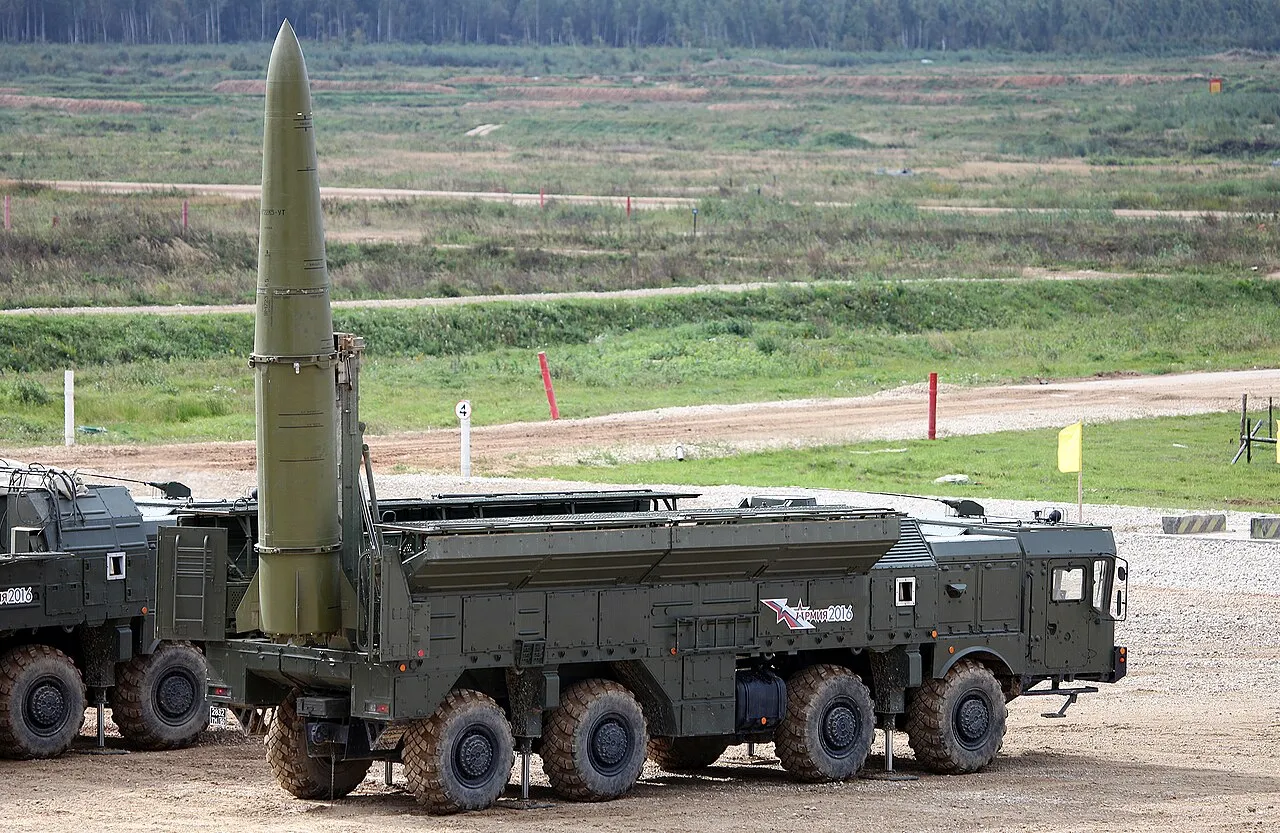
The 9K720 Iskander, known to NATO as the SS-26 Stone, is a road-mobile short-range ballistic missile system developed by the KBM design bureau in Kolomna and fielded by Russia since 2006. Each wheeled launcher carries two ballistic or cruise missiles, and the same vehicle can fire the 9M723 ballistic missile or the 9M728 and 9M729 cruise missiles. Russia’s missile brigades operate the domestic Iskander-M; Armenia and Algeria bought the export model1, and Russia deployed systems to Belarus in 20222. Ukraine’s air force lists Iskander-M missiles in its reports on Russian overnight attacks, as it did for the night of 21–22 July 20263.
Design and development
Work on the system followed the 1987 INF Treaty, which banned its predecessor, the OTR-23 Oka; KBM modified the Oka’s solid rocket motor for the new missile. Analysts at RUSI see the Oka, not the OTR-21 Tochka, as the direct technological predecessor of the 9M7234. KBM began developing the Iskander complex in 1993, Army Technology dates the first test firing to 19965, and state trials from 1998 to 2005 comprised 13 flights at the Kapustin Yar range. An improved missile, the 9M723-1, was tested in 2010 and accepted into service in 2012, the year an optional optical seeker also entered service1.
A brigade has three battalions of four launchers, 12 launchers in all, backed by 9T250E transporter-loaders, a 9S552 command post vehicle and a 9S920 information processing station4. Each transporter-loader carries two reload missiles and a crane5.
Specifications
The launcher, designated 9P78-1, rides on an 8x8 MZKT-7930 all-terrain chassis built in Minsk, Belarus. RUSI gives its gross vehicle weight as 42.3 tonnes, the figure Army Technology lists for the launcher with missiles5, while CSIS puts it at 43 tonnes with two missiles aboard. A 500-horsepower YaMZ-846 diesel gives it a road speed of 70 km/h. For road range, CSIS gives 1,100 km and Army Recognition 1,000 km6. The launcher has a crew of three, and its cabin is hardened against chemical, biological, radiological and nuclear hazards1. According to RUSI, both missiles can be fired within one minute4 of each other.
Armament and protection
The 9M723 ballistic missile is 7.3 m long and 0.92 m in diameter and uses a single-stage solid-propellant motor. CSIS gives it a maximum range of 500 km with payloads of 480 to 700 kg; RUSI analysts write that the range can be doubled depending on warhead size and trajectory4. Conventional warheads listed by CSIS are high-explosive, submunition, earth-penetrator and thermobaric. According to CSIS, the missile flies a depressed trajectory and can maneuver at up to 30 g1.
The 9M728 cruise missile, also called the R-500, carries a 480 kg warhead over 500 km4. The US Congressional Research Service describes the Iskander ballistic and cruise missiles as dual-capable, carrying either nuclear or conventional warheads7. On the launcher, an armored roof covers the two missiles1.
Variants
The Iskander-M fires the 9M723, which CSIS describes as reserved for the Russian military. The export Iskander-E fires the 9M720, with a range cut to 280 km and a 480 kg payload1; Army Technology says it was designed to meet Missile Technology Control Regime guidelines and uses inertial guidance5.
Iskander-K is the informal name for the launcher armed with two 9M728 cruise missiles, first flight-tested in 2007 and reportedly in service from 2013. In 2019 Russia displayed a launcher carrying four 9M729 missiles, which CSIS credits with a range of 2,500 km8. The State Department’s compliance reports from 2014 to 2018 found Russia in violation of the INF Treaty over a ground-launched cruise missile with a range of 500 to 5,500 km, which Washington named as the 9M729 in late November 2017. Russia acknowledged the missile but denied it could fly to INF range9, and the United States cited it as a major factor in its 2019 withdrawal1 from the treaty. The US National Air and Space Intelligence Center assesses the air-launched Kinzhal as essentially an air-delivered Iskander7.
Operators and service
CSIS counted 11 Russian Iskander-M brigades as of 2019; KBM delivered the last brigade set in November 2019. Russia first used the system against Georgia in 2008; a unit sent to Syria in 2016 did not fire in combat, according to CSIS. After deployments to Kaliningrad in 2013, 2015 and 2016, Russia has based Iskander-M there permanently since 20181. After Dmitry Medvedev warned in April 2022 that Russia would have to reinforce its Baltic borders if Sweden and Finland applied to join NATO, Lithuania’s defense minister said Russia stored nuclear warheads for Iskander in Kaliningrad, a claim other analysts questioned7.
Armenia became the first export buyer in 2016, and Algeria bought four Iskander-E regiments with 48 launchers in 20171. After the 2020 war with Azerbaijan, former Armenian president Serzh Sarkisian said the missiles had not been used adequately; Prime Minister Nikol Pashinian replied in February 2021 by asking why the fired Iskander did not explode, or exploded “by, say, 10 percent”, remarks a senior Russian lawmaker called a “complete lie”10. In June 2022 President Vladimir Putin said Russia would hand Iskander-M systems to Belarus within months, describing them as able to fire conventional and nuclear missiles11. In December 2022 a Belarusian defense ministry official said the Iskander and S-400 systems Russia had deployed there were on combat duty2.
In 2022 RUSI cited an Iskander attack on a Buk-M1 air defense vehicle4 in Ukraine as an example of a mobile target that older systems could not have hit. For the night of 21–22 July 2026, Ukraine’s air force reported one Iskander-M launched from occupied Crimea and recorded hits by that missile and 12 drones at 12 locations3. The air force sometimes reports a combined category, Iskander-M/KN-23, which adds the North Korean KN-2312: on 24 May 2025 it said Russia had launched 14 such missiles and that six aimed at Kyiv were intercepted13.
Similar vehicles
The OTR-21 Tochka-U and the OTR-23 Oka are the earlier launchers that Iskander replaced in Russian service1. The KN-23 is a North Korean short-range ballistic missile that shares a reporting category with Iskander-M13 in Ukraine’s air force summaries; analysts who hold that it was built at home point to its elongated cable raceway and smooth base12. Iran’s Fateh-110 is a road-mobile, solid-propellant short-range ballistic missile with a shorter range of 200 to 300 km14. The American ATACMS is a road-mobile short-range ballistic missile typically deployed from modified MLRS launch vehicles, and a HIMARS can carry and fire a single ATACMS Block 115.