Contents
The Leopard 2 is a German main battle tank that was developed by Krauss-Maffei in the 1970s and entered service in 19791, replacing the Leopard 1 in the West German army. It is a product of KNDS Deutschland, while Rheinmetall supplies its 120mm smoothbore gun and the tank’s fire control technology and C4I systems. KNDS gives a fleet of over 3,500 units in service across 22 nations3. Rheinmetall calls it the tank deployed by more nations than any other2.
Design and development
West Germany began developing the MBT-70 with the United States in 1963, and by 1967 it had become questionable whether that tank would enter service in the foreseeable future, so the government asked Porsche to study upgrades to the Leopard 1. In July 1973 the West German and US defense ministers agreed that more standardization of main battle tanks would favor NATO, and the United States evaluated a Leopard 2AV prototype against its XM1 Abrams; the Leopard 2AV fully met the U.S. requirements1, but West Germany later withdrew its tank from consideration.
In September 1977 West Germany ordered 1,800 Leopard 2 tanks in five batches. Krauss-Maffei was the main contractor, and Maschinenbau Kiel won a contract to build 45% of the tanks. The first series-production tank was delivered on 25 October 19791.
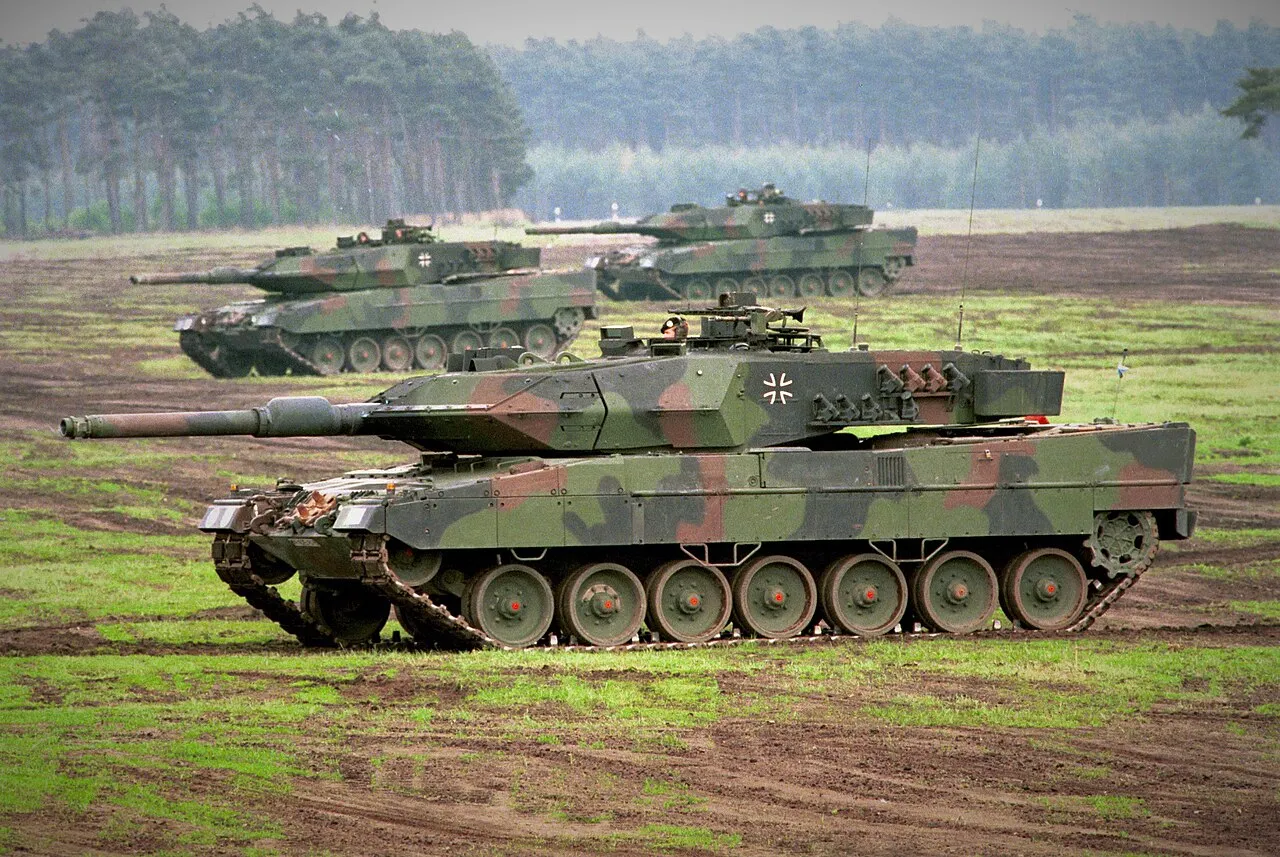
The tank falls into two main development tranches1. Tanks up to the Leopard 2A4 standard have vertically faced turret armor; from the Leopard 2A5 onward the turret carries angled, arrow-shaped appliqué armor, together with other improvements. KNDS credits the tank’s modular configuration3 with keeping it in use far into the mid-21st century.
Specifications
Weight has risen with each upgrade. KNDS lists the Leopard 2A4 at 55 t, the 2A5 at 62 t and the current 2A7V at under 69 t. Engine output stayed the same across all three: KNDS gives 1,500 hp (1,100 kW)6 for the 2A7V, as it does for the 2A55 and the 2A44. That power comes from the MTU MB 873 Ka-5011, a four-stroke, 47.7-liter, twin-turbocharged and liquid-cooled V12 diesel with multi-fuel capability, coupled to the Renk HSWL 354 gear and brake system.
For the 2A7V, KNDS gives a top speed of up to 70 km/h and a range of 450 km. With the turret at 12 o’clock that version is up to 10.97 m long and 3.77 m to 4.00 m wide6. The older 2A5 is 9.67 m long and 3.67 m wide, and both stand 2.64 m to the turret roof5.
Armament and protection
The main gun of every production Leopard 2 is the Rheinmetall 120 mm smoothbore gun, the same gun later adapted for the M1 Abrams. Tanks up to the 2A5 carry the L/44 version and the Leopard 2A6 and later models the longer L/55. KNDS lists the 2A5 with the L44 gun and a 7.62mm machine gun5, and the 2A7V with an L55 or L55A1 gun, which can fire programmable ammunition. An optional remote weapon station on the 2A7V can take a 40mm automatic grenade launcher or .50 MG6. The hull magazine holds 27 rounds, with 15 more in the turret bustle1 behind an electrically operated door.
The tank uses spaced multilayer armor throughout the design1, made of steel plates of different hardness, elastic materials and other non-metallic materials. Its layout follows the concept of compartmentation: in the turret, the ammunition and the hydraulics sit in compartments separated from the crew, and blow-off panels on the compartment roofs direct an explosion and fire away from the crew. KNDS says the 2A7V has passive all-round protection for the crew6 from threats such as IEDs, mines or anti-tank fire, a reinforced hull area against mines, and extra protection for the turret crew against threats from above.
Variants
KNDS says the Leopard 2A4 was developed further to meet specific customer requirements, and that one such version gave the Canadian army the world’s first Leopard 2 with additional all-round protection4 from IEDs and modern hand-held anti-tank weapons. The Leopard 2A5, which KNDS describes as the first upgrade5 of the tank, added armored roof and front protection plates to the turret and chassis. In June 1994 Sweden ordered 120 modified Leopard 2A5 tanks, known in Swedish service as the Stridsvagn 122, with Swedish-developed appliqué armor, a new command system and improved electronics. Spain’s Leopard 2E is a derivative of the 2A6, with greater armour protection1, co-produced by the Spanish and German defense industries.
The Leopard 2A7V, in KNDS’s words developed and qualified for the new tasks of the German Bundeswehr6, carries improved optronics and a command and information system. The Leopard 2A8 is based on the Leopard 2A7HU, with the Trophy active protection system1 and an all-round situational awareness system among its improvements. KNDS also offers the Leopard 2 A-RC 3.0, an upgrade to unmanned turret technology3.
Operators and service
KNDS names Germany, Switzerland, Spain, Denmark and Sweden among the reference customers for the Leopard family6. Turkey ordered 298 Leopard 2 tanks from German army stocks in 2005, and Greece ordered 170 Leopard 2 tanks in March 2003, of which 140 were locally assembled. To replace the eighteen Leopard 2A6 tanks it handed to Ukraine, Germany began planning a purchase of eighteen Leopard 2A8s in May 2023; in July 2024 Germany’s budget committee approved 105 more 2A8 tanks, with deliveries planned between 2027 and 20301.
German Leopard 2A5s went to Kosovo with the Kosovo Force starting on 12 June 1999, where they were used for patrols and to protect checkpoints and bases. In the 2000s Dutch, Danish and Canadian forces deployed their Leopard 2s in Afghanistan as part of the International Security Assistance Force; Canada borrowed 20 Leopard 2A6s and three armoured recovery vehicles from Germany for that deployment. Turkish Leopard 2A4s deployed to the Syrian Civil War in December 20161 during Operation Euphrates Shield. Since 2023, Ukrainian Leopard 2 tanks have seen action in the Russo-Ukrainian War, supplied by operators including Germany, Poland and Canada.
Similar vehicles
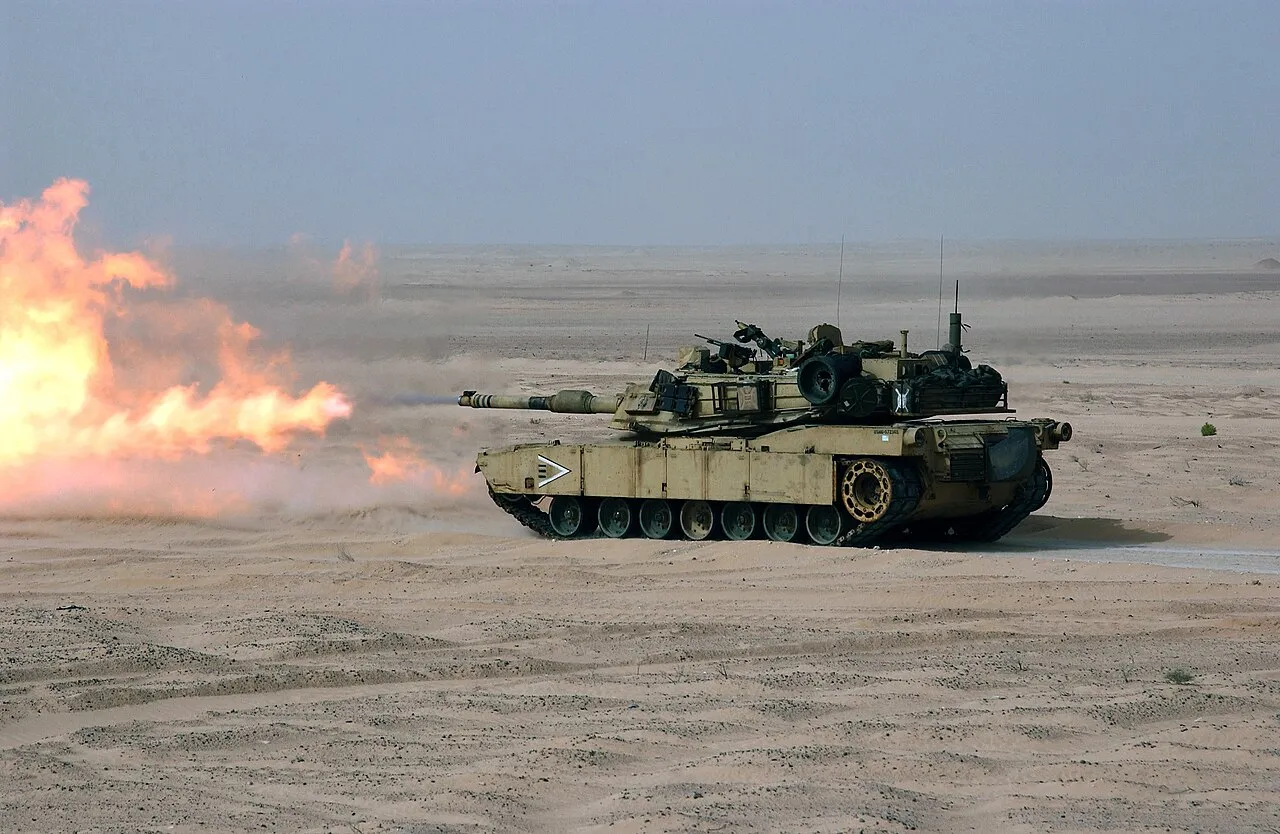
The M1 Abrams carries a Rheinmetall-derived 120 mm gun too, but its powertrain is an AGT1500 multifuel gas turbine7 rather than a diesel. The French Leclerc main battle tank loads its gun with an autoloader located inside the turret bustle8. The British Challenger 2’s main armament is an L30A1 120 mm rifled tank gun9, against the Leopard 2’s smoothbore.