Contents
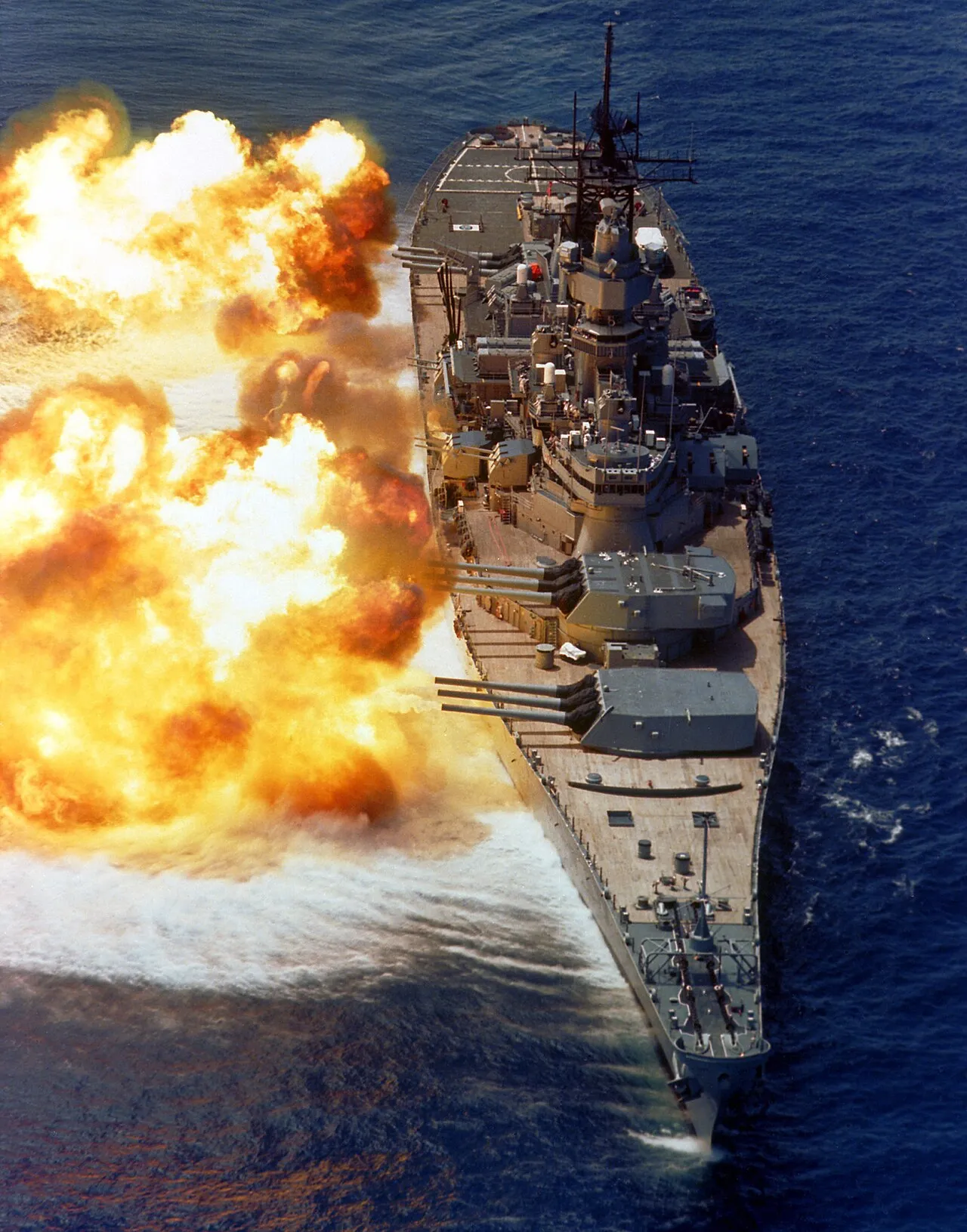
The Iowa class was a class of six fast battleships ordered in 1939 and 1940 for the United States Navy. Four were completed: Iowa, New Jersey, Missouri and Wisconsin; Illinois and Kentucky were laid down but canceled. The lead ship, USS Iowa (BB-61), was commissioned on 22 February 1943. The four were the last battleships commissioned in the U.S. Navy1. The last of them left service in March 19922, when Missouri was decommissioned.
Design and development
The ships grew out of War Plan Orange, a Pacific war plan against Japan, and were initially intended to intercept fast capital ships such as the Japanese Kongō-class battlecruisers. The design was drawn up to the Second London Naval Treaty’s “escalator clause” limit of 45,000 long tons (45,700 t) standard displacement. The Second Vinson Act of May 1938 funded the class, and each ship cost approximately US$100 million1.
In November 1938 the Bureau of Ordnance and the Bureau of Construction and Repair found that their turret and barbette plans could not go together; a new, lighter 50-caliber gun, the Mark 7, fit the smaller barbette and saved nearly 850 long tons. The New York Navy Yard built Iowa and Missouri, the Philadelphia Navy Yard New Jersey and Wisconsin2. The “all-or-nothing” armor was largely modeled on the South Dakota class, with a main belt 12.1 inches (307 mm) thick sloped at 19 degrees1.
Specifications
At 887 ft 3 in (270.43 m) long overall with a beam of 108 ft 2 in (32.97 m), the ships were sized to pass the 110 ft (34 m) wide Panama Canal. Full-load displacement was 57,540 long tons (58,460 t). Eight boilers, four geared turbines and four shafts give 212,000 shaft horsepower, for a published top speed of 32.5 knots at full load and 33 knots at normal displacement1. The FAS lists a ship’s company of 65 officers and 1,450 enlisted, plus 58 Marines2.
Armament and sensors
The main battery is nine 16-inch/50-caliber Mark 7 guns2 in three turrets. The guns fire the 2,700 lb (1,225 kg) armor-piercing Mark 8 and the 1,900 lb (862 kg)3 high-capacity Mark 13, and their maximum range was 42,345 yards (38.7 km). At commissioning the ships also carried twenty 5-inch/38-caliber guns in ten mounts and 20 quad 40 mm mounts and 49 single 20 mm mounts1.
The 1980s modernization removed the light anti-aircraft guns and four of the ten 5-inch mounts1 to make room for armored box launchers for Tomahawk missiles. As rebuilt, each ship carried 32 Tomahawk missiles in eight armored box launchers, 16 Harpoon anti-ship missiles, 12 five-inch guns and four 20 mm Phalanx close-in weapon systems, with an SPS-49 air search radar and an SPS-67 surface search radar2.
Variants
On Missouri and Wisconsin the transverse bulkheads closing the armored citadel were increased from 11.3 to 14.5 inches against raking fire from ahead. Several conversions were proposed but never authorized: Kentucky was reclassified from BB-66 to BBG-1 under plans to complete her as a guided-missile battleship, and proposals the Navy considered to remove the aft 16-inch turret were dropped in 19841.
Ships in class
- Iowa (BB-61): commissioned 22 February 1943, decommissioned 26 October 19902; opened as a museum ship in San Pedro, Los Angeles, on 7 July 20121.
- New Jersey (BB-62): commissioned 23 May 1943, decommissioned 8 February 19912; donated to the Home Port Alliance of Camden, New Jersey, as a museum ship in October 20011.
- Missouri (BB-63): commissioned 11 June 1944, decommissioned 31 March 19922; donated to the USS Missouri Memorial Association of Pearl Harbor as a museum ship in 19991.
- Wisconsin (BB-64): commissioned 16 April 1944, decommissioned 30 September 19912; stricken on 17 March 2006 so she could be transferred as a museum ship; berthed at the Nauticus maritime museum in Norfolk, Virginia, as of 20261.
- Illinois (BB-65): assigned to the Philadelphia Navy Yard and canceled on 12 August 19452.
- Kentucky (BB-66): keel laid in March 1942, work suspended in June 1942 and February 1947 with the hull complete only up to the second deck. Her bow was removed in 1956 to repair Wisconsin, the hull was sold for scrapping in October 1958, and her engines went to the support ships USS Sacramento and USS Camden2.
Service history
In the Pacific the class served mostly as escorts for the Fast Carrier Task Force and for shore bombardment. Off Truk on 16 February 1944, New Jersey straddled the Japanese destroyer Nowaki at 35,700 yards, the longest-ranged straddle on record. Japan’s representatives signed the surrender documents aboard Missouri in September 1945. Three were recalled for the Korean War, and New Jersey shelled Viet Cong and Vietnam People’s Army forces in 19681.
Congress directed the reactivation of the first ship in the summer of 1981. The four were recommissioned between December 1982 and October 1988, at a cost of about $1.7 billion. On 19 April 1989, an explosion of undetermined cause in Iowa’s Number Two turret killed 47 crewmen2. In Operation Desert Storm, Missouri fired 28 Tomahawk missiles and 759 16-inch shells and Wisconsin 24 Tomahawks and 319 16-inch shells1. NavWeaps dates the end of the big-gun battleship era to 16 May 19913, when Wisconsin fired her guns for the last time.
The battleships were removed from the Naval Vessel Register in January 1995. The defense authorization act for fiscal year 1996 then required the Navy to keep at least two of them2 on the register for amphibious fire support; those two were stricken in 20061.
Similar classes
- South Dakota class: the preceding US class, designed for a battle line speed of 27 knots1; the Iowas’ armor scheme was largely modeled on it.
- Montana class: the “slow” design studies became the 60,500-long-ton Montana class with twelve 16-inch guns1.
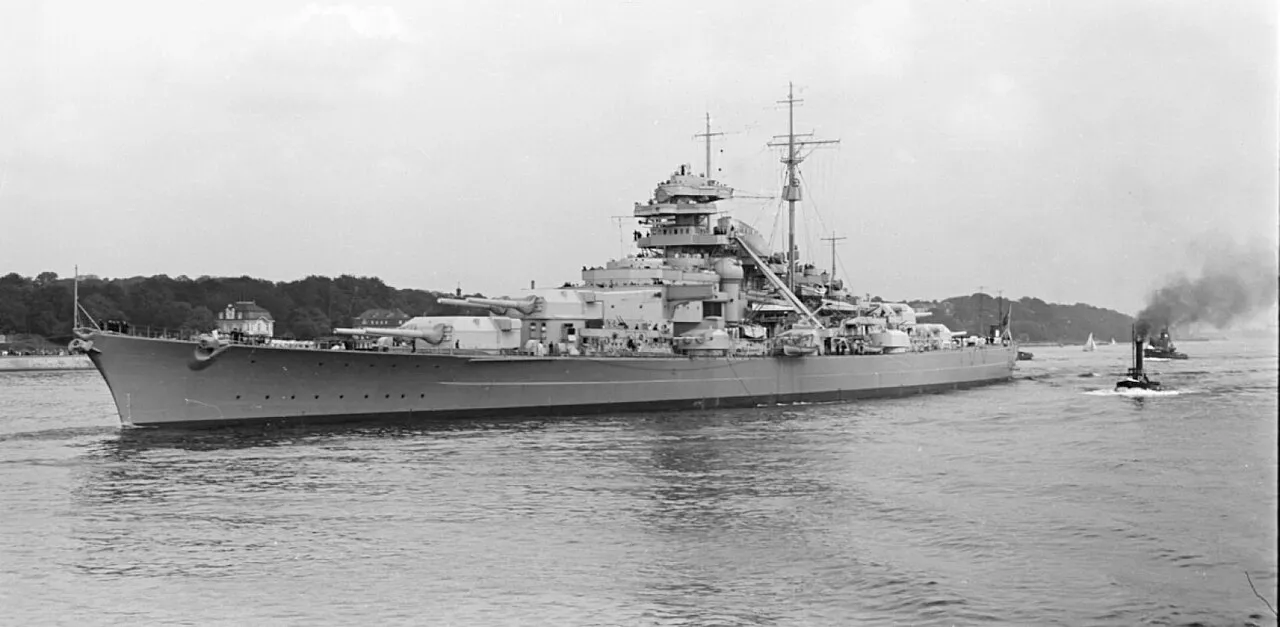
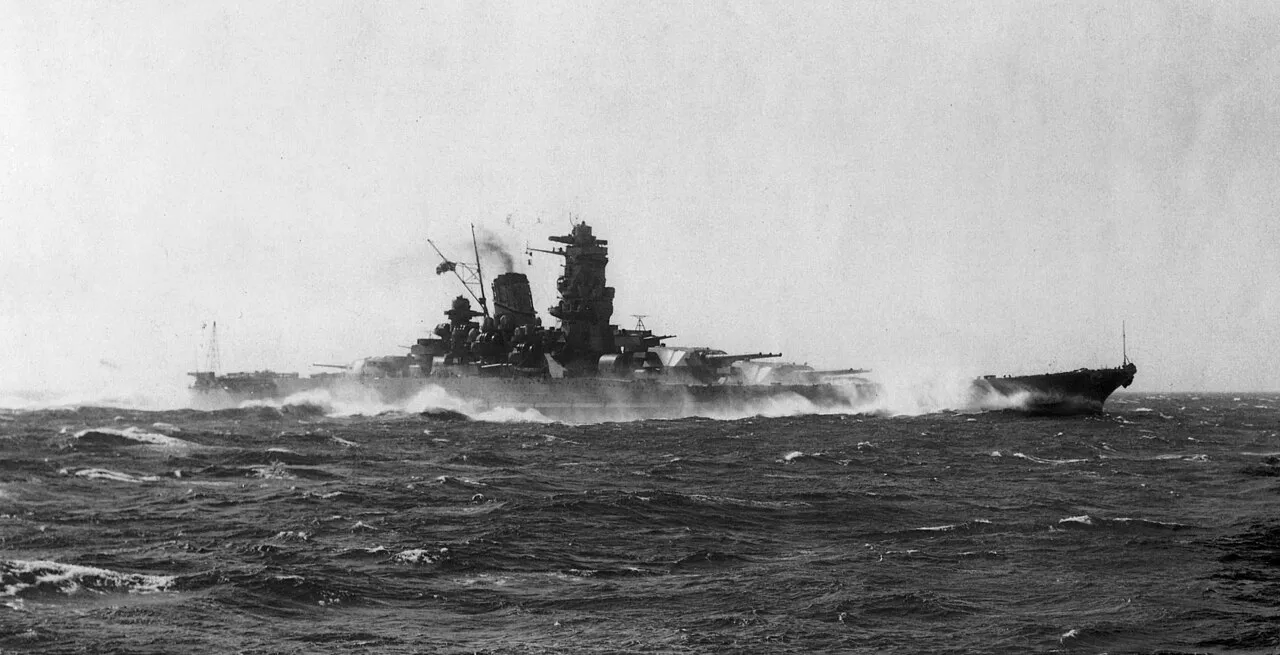
- Yamato class: the Japanese class whose 46 cm guns3 the Iowas’ main guns nearly matched in penetration, according to NavWeaps; see Japanese battleship Yamato.