Contents
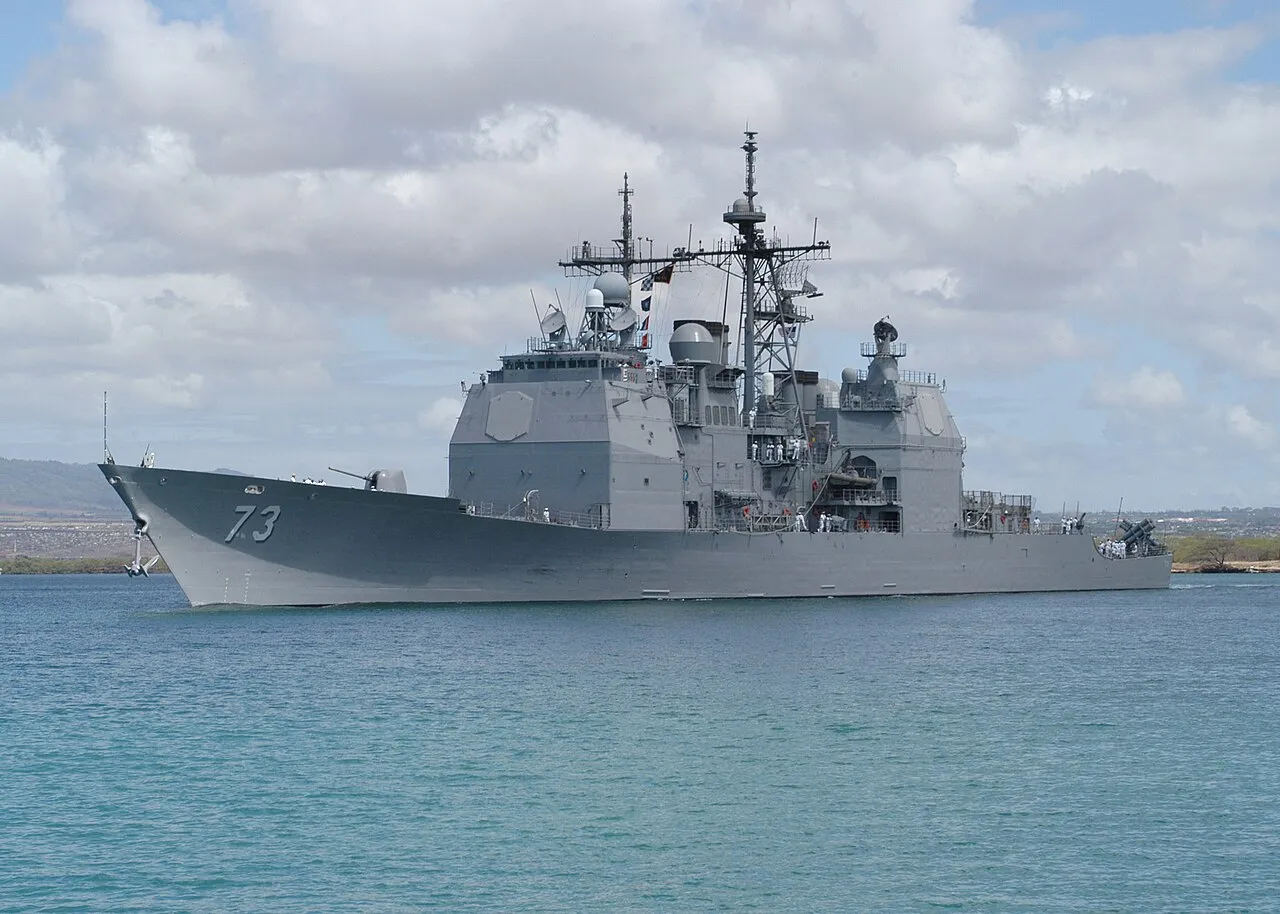
The Ticonderoga class is a class of guided-missile cruisers of the United States Navy, first ordered and authorized in fiscal year 1978. They were the first surface combatant ships equipped with the Aegis weapons system, built around a radar that can scan for threats, track targets and guide missiles3 at the same time. The lead ship, USS Ticonderoga (CG-47), was commissioned on 22 January 1983, and USS Port Royal (CG-73), commissioned on 9 July 1994, was the last of 27 ships2. As of September 2026, five ships remain active; the class is being retired, with the last ships scheduled for decommissioning by 20301.
Design and development
The class used the Spruance-class hull and was first designated a guided-missile destroyer (DDG) before being redesignated a guided-missile cruiser on January 1, 19802. Under Admiral Elmo Zumwalt’s “high-low mix”, the ships were meant as lower-cost platforms for the new Aegis Combat System, alongside a much larger strike cruiser; after the strike cruiser was canceled, the role was transferred to the DDG-47. The added combat capability of Aegis and the SPY-1 radar, and the ability to serve as a flagship, were used to justify the change of classification1.
The ships were built in sections called modules, an advance over traditional shipbuilding, where systems are installed below decks after the hull is finished. At Ingalls, four pre-outfitted hull and superstructure modules were joined shortly before launch, and each ship was moved several hundred yards across land to a floating dry dock2, which launched it.
The Aegis system and the extra cruiser roles added substantial weight to the Spruance-derived hull, which left the design with limited growth potential in weight and power margin. Some cruisers reported structural problems in early service after extended periods in extremely heavy seas1, and several had superstructure cracks repaired. Growing costs and delays, along with worsening cracking and other structural issues4, later led the Navy to reassess its plans to modernize the ships.
Specifications
A Ticonderoga measures 567 feet from bow to stern with a beam of 55 feet, or 173 m by 16.8 m. Army Recognition gives a full-load displacement of 9,600 tons3; the Federation of American Scientists lists 9,957 tons full and 7,103 tons light2. The bigger ship and its equipment took displacement up from 6,900 tons for the DD-963-class destroyers to 9,600 tons1.
Four General Electric LM-2500 gas turbines with 80,000 shaft horsepower drive two controllable-reversible pitch propellers, giving a speed of greater than 30 knots. The range is 6,000 nautical miles at 20 knots. The Federation of American Scientists lists a crew of 24 officers and 340 enlisted2; Army Recognition gives about 3303.
Armament and sensors
The heart of Aegis is the SPY-1A radar, which detects and tracks air contacts to beyond 200 miles. The earlier ships carry the AN/SPY-1A with four arrays, the later ones the AN/SPY-1B(V) multi-function radar2. The ships were designed from the outset as command and control platforms4, a role that keeps them central to carrier strike groups.
From Bunker Hill (CG-52) on, the main weapons sit in 122 Mk 41 vertical launch cells, 61 forward behind the main gun and 61 aft behind the helicopter hangar. Those cells take Standard surface-to-air missiles, the Evolved SeaSparrow, Tomahawk cruise missiles and VL-ASROC. Ships with Aegis Baseline 5.3.9 can also deploy the SM-3 anti-ballistic missile. Other weapons include two 127 mm Mk 45 guns, two Phalanx close-in weapon systems and two quadruple Harpoon launchers3. Against submarines, the ships carry a hull-mounted sonar, a towed array and a helicopter that can locate ships or submarines over 100 miles away; later cruisers embark two SH-60 Sea Hawk (LAMPS III)2 helicopters.
Variants
The first five ships, Ticonderoga (CG-47) through Thomas S. Gates (CG-51), have an early, less capable version of Aegis and no vertical launch system or Tomahawk capability. They carry two Mk 26 missile launchers, one fore and one aft3, which limited their missile capacity to 88. The twenty-two cruisers starting with CG-52 have vertical launch systems instead, which were adopted to reduce manpower requirements1. The first two ships also carried two SH-2F helicopters instead of the SH-60B2.
USS Yorktown (CG-48) was nominated as the ship for the Smart Ship Project, which set out to show in an operational ship that workload and crew could be reduced. Its changes took the bridge watch from 13 personnel to 3 and cut the crew by 44 enlisted personnel and 4 officers2.
The Navy originally planned to put 11 of the Ticonderogas through a modernization program to serve into the 2030s. The work includes Aegis improvements, a new AN/SPQ-9B radar and an updated SQQ-89A(V)15 sonar suite4. Such upgrades can cost up to $250 million per ship1. The first five cruisers were left out of the Cruiser Conversion program because of affordability2.
Ships in class
Of the 27 ships, 19 were built by Ingalls Shipbuilding and eight by Bath Iron Works. All but one, Thomas S. Gates, were originally named for noteworthy events in US military history, and Chancellorsville was renamed USS Robert Smalls (CG-62) in March 2023. All five Mk 26 ships have been decommissioned; Ticonderoga was decommissioned on 30 September 2004 and scrapped in 20221.
In 2022 the Navy announced its intention to decommission all of the remaining cruisers by 2027. In November 2024, the Navy announced that Gettysburg, Chosin and Cape St. George would have their service lives extended through 2029. Cape St. George was then the youngest still-serving Ticonderoga4. Lake Erie was decommissioned on 25 September 2026 and Shiloh on 30 September 20261.
Service history
On 3 July 1988, amid a running gun battle with Iranian Revolutionary Guard gunboats, USS Vincennes (CG-49) shot down Iran Air Flight 655 with two SM-2MR surface-to-air missiles. All 290 people on board were killed5. The commanding officer believed the airliner to be an Iranian Air Force F-141, and the investigation recommended that the Aegis large-screen display be changed to show altitude.
During Operation Desert Storm, on 18 February 1991, two Italian-made Manta mines detonated in the Persian Gulf, one just under the port rudder of USS Princeton (CG-59). Three crewmembers were injured, and the forward weapons and Aegis were back online within 15 minutes. In December 19986, Princeton and USS Antietam (CG-54) launched cruise missiles at Iraq in Operation Desert Fox.
On 20 February 2008, USS Lake Erie (CG-70) fired an SM-3 that struck the dead satellite USA-193, making it the first US Navy warship to shoot down an in-orbit satellite. On 22 December 2024, USS Gettysburg (CG-64) shot down an F/A-18F Super Hornet from USS Harry S. Truman; US Central Command stated that both crew ejected and were recovered1 and that it was not the result of hostile fire. In October 20244, USS Chosin (CG-65) took part in a test of a system for restocking Mk 41 cells at sea.
Similar classes
- Arleigh Burke-class destroyer: the Navy’s Aegis destroyers carry their SPY-1D arrays clustered on the forward deckhouse1, where a Ticonderoga splits them across two deckhouses, and they have 90 or 96 Mk 41 cells against the cruiser’s 1224.
- Slava-class cruiser: the Soviet cruiser of the same era was designed around the P-500 Bazalt missile, and only three were completed7.
- Zumwalt-class destroyer: earlier plans for a direct Ticonderoga replacement evolved into the Zumwalt class4, of which the Navy acquired just three stealth destroyers.