Contents
The Type 26 is the Royal Navy’s coming class of anti-submarine frigates, which the Ministry of Defence’s procurement agency calls the Royal Navy’s most advanced Anti-Submarine Warfare warship of her time. The programme consists of eight ships and will be known as the City class, all built by BAE Systems in Glasgow. The ships replace the Type 23 anti-submarine frigates and are designed to protect the UK’s Continuous At-Sea Deterrent and Carrier Strike Group. None is in service yet: the first frigate is expected to be operational in 20281, and the eight are expected to enter service between 2028 and 20352, based at HMNB Devonport in Plymouth.
The same design is also being built abroad. Australia, Canada and Norway have selected the design for their navies3, making it, in the agency’s words, a 32-ship endeavour across three independent national programmes1.
Design and development
The programme began in 1998 as the Future Surface Combatant4, which by March 2010 had become the Global Combat Ship under a £127 million design contract to BAE Systems. BAE describes the Global Combat Ship as a multi-mission warship with a common acoustically quiet hull5 shared by all variants, a modular design and an open systems architecture so that it can be upgraded as technology develops.
The Royal Navy first planned thirteen Global Combat Ships, eight for anti-submarine work and five general-purpose ships. The 2015 Strategic Defence and Security Review cut the order to the eight anti-submarine ships, and the money for the other five went to the cheaper Type 31 frigate. BAE received a contract worth about £3.7bn6 to build the first three ships in 2017, and steel was cut on the first, HMS Glasgow, on 20 July 20174. A second contract worth £4.2bn was signed in November 20221 for the final five.
Specifications
The procurement agency gives a displacement of 6,900 t, a length of 149.9 m and a beam of 20.8 m1. A later release from the same agency, of December 2025, describes the ships as 149-metre-long 8,000-tonne frigates2. The government puts the length at just under 150m7, the top speed at more than 26 knots and the range at more than 7,000 nautical miles. BAE gives that range in excess of 7,000 nautical miles in Electric-Motor drive5.
The agency lists a crew of 1611. BAE gives a 157 core complement5 with accommodation for 208.
Propulsion is a combined diesel-electric or gas (CODLOG) system4: a gas turbine drives the shafts directly, and four high-speed diesel generators power two electric motors. The gas turbine is the Rolls-Royce MT30. On the diesel generators, the agency says they provide reliable power to propel the ship quietly2 while powering her equipment, a capability it calls crucial for anti-submarine warfare. The government adds that the hull is hydrodynamically designed7 to optimise fuel efficiency, with a diesel emissions abatement system.
Armament and sensors
The government lists the Sea Ceptor missile defence system7, a five-inch medium calibre gun, an embarked helicopter, radar and sonar, and a Mk 41 vertical launch silo. The Mk 41 has 24 strike-length cells forward of the bridge. In July 2021 it was confirmed that the Anglo-French-Italian Future Cruise/Anti-Ship Weapon would be brought into service on the Type 26, likely launched from the Mk 41. The gun is a 5-inch, 62-calibre Mark 45, and the smaller weapons include two Phalanx close-in weapon systems and two 30 mm DS30M Mark 2 guns. The ships carry the Type 997 Artisan 3D search radar4.
For submarine hunting the ships carry an Ultra Electronics Type 2150 bow sonar4 and a Sonar 2087 towed array. BAE describes an Integrated Mission Bay and Hanger5 able to support multiple helicopters, uncrewed underwater vehicles, boats and disaster-relief stores, and a flight deck capable of landing a Chinook helicopter. The government says the mission bay means the ships could also be adapted7 to carry specific forces and equipment.
Variants
The British ships are the City class. Australia’s version is the Hunter class: BAE Systems Australia is designing and building six for the Royal Australian Navy. Canada chose the design for its 15-ship River class destroyer programme, with BAE as warship designer under Lockheed Martin Canada and Irving Shipbuilding as the shipbuilder. Norway announced in August 2025 that it intends to procure at least five Type 26 frigates5, in a deal the British government values at £10 billion3.
Ships in class
The eight Royal Navy ships will be named HMS Glasgow, HMS Cardiff, HMS Belfast, HMS Birmingham, HMS Sheffield, HMS Newcastle, HMS Edinburgh and HMS London. They are built at BAE Systems’ Govan and Scotstoun shipyards in Glasgow, and construction of all ships is scheduled to be completed by end of 20331.
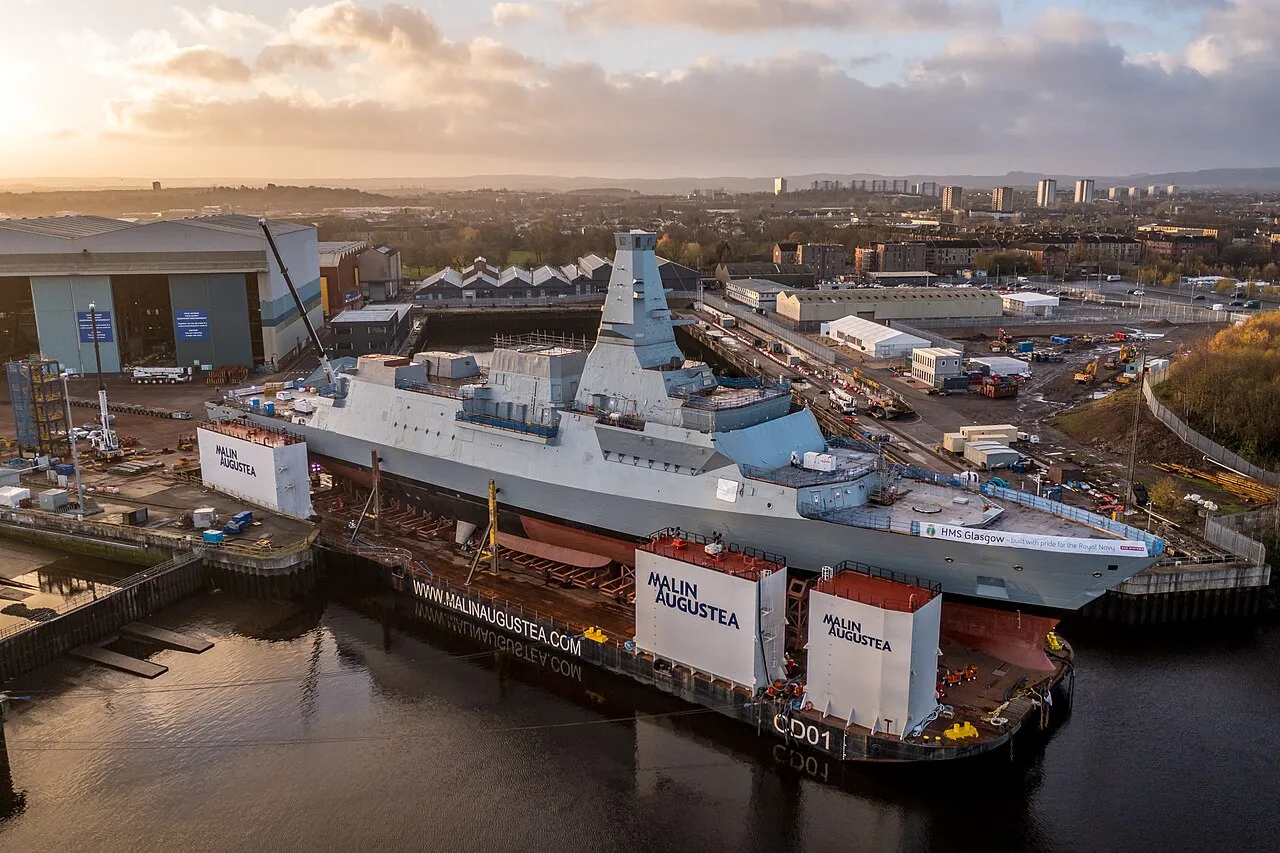
The lead ship, HMS Glasgow, was launched on 3 December 2022 and HMS Cardiff on 5 September 2024; both were fitting out after launch. In December 2025 Glasgow’s diesel generators were started for the first time2, so that she generates her own power as her build continues. Steel had been cut for Belfast, Birmingham and Sheffield by November 20244. To speed up the second batch, BAE applied to build a 175 metre long, 85 metre wide Shipbuilding Hall7 at Govan, in which two frigates can be built at once under cover.
Service history
The ships are planned as the backbone of the Royal Navy’s surface presence into the 2060s1. Under the Norwegian deal the eight British and at least five Norwegian ships are to form a combined fleet of 13 Anti-Submarine Warfare frigates3 operating jointly in Northern Europe, with shared maintenance, crew training and in-service support.
Similar classes
- Type 31 frigate: the Royal Navy’s other new frigate class, funded from the five general-purpose Type 26 ships that were cut, as a lighter and lower cost general-purpose frigate4 rather than a specialist submarine hunter.
- Type 23 frigate: the anti-submarine frigates the Type 26 replaces; its CODLAG propulsion4 is the more complex system from which the Type 26’s CODLOG arrangement is simplified.
- FREMM multipurpose frigate: a Franco-Italian design4 adopted by the navies of France, Italy, Morocco and Egypt, where the Type 26 is a British design.