Contents
The Type 31 is a class of next-generation frigates for the Royal Navy, known as the Inspiration Class. The five T31s are replacing the five general purpose T23 frigates as those ships come out of service. The Ministry of Defence says they will work alongside new Type-26 frigates dedicated to submarine detection. Babcock International builds them at its Rosyth facility, in Scotland, on its Arrowhead 140 design2. As of 2026 none of the five was in service, and the lead ship was anticipated for service entry “by the end of the decade”3. When it named them, the Ministry of Defence said the ships were expected to enter service by 20281. Defence Equipment & Support (DE&S), the ministry’s procurement arm, says all five are scheduled to be in service by the early 2030s4.
The ships were named in May 2021: HMS Active, HMS Bulldog, HMS Campbeltown, HMS Formidable and HMS Venturer. The names are drawn from former warships and submarines. Venturer recalls the World War II submarine that sank U864 on February 9 19451 while both boats were submerged.
Design and development
The 2010 Strategic Defence and Security Review set up the Global Combat Ship program to replace the Royal Navy’s thirteen Type 23 frigates. The 2015 review changed this to eight anti-submarine Type 26 frigates and five general purpose frigates of a different design. That general-purpose frigate was meant to be a lighter, flexible and more affordable3 class.
Babcock, BMT and Thales announced the Arrowhead 140 in late May 2018, based on the hull of the Danish Iver Huitfeldt-class frigates. The competition was suspended on 20 July 2018 because too few compliant bids had come in, and restarted in August 20183. Babcock was awarded the contract in November 20192. Naval News reported an average production cost of £250 million per ship and an overall program cost of £2 billion. It also reported that the Danish design was adapted to Royal Navy requirement by Babcock and BMT5, with Thales supplying the combat management system.
DE&S describes the ships as flexible and adaptable by design. Mission bays allow them to be re-equipped for tasks such as interception, collecting intelligence, defense engagement and assisting those in need. A modular design allows for the easy swapping of systems2 to suit each mission. In May 2026 the program was reported to have incurred £140 million in cost overruns3 because of design changes and out-of-sequence build work earlier in the program.
Specifications
DE&S gives a displacement of 5,700 t, a length of 138 m and a beam of 19.8 m. It puts the maximum speed at 28 knots and the crew at 1052. The range is 7,500 nautical miles3.
The ships use four MTU 20V 8000 M71 diesel engines3 in a combined diesel and diesel arrangement driving two shafts. They are designed to operate with a Merlin or Wildcat helicopter2.
Armament and sensors
DE&S says the ships will carry the world-leading UK-designed and manufactured missile system and a 4D air and surface surveillance and target indication radar2. Forces News reported in 2019 that the design would have Sea Ceptor (CAMM) missiles, and the radar is the Thales NS110. In October 2020 BAE Systems Bofors announced it was under contract to supply five 57 mm Mk3 guns and ten 40 mm Mk4 guns for the class. Each ship is to carry one 57 mm gun in the A position and two 40 mm guns in B and Y. In March 20243 it was announced that SEA’s Ancilia trainable decoy launcher would replace the Sea Gnat system across the Royal Navy’s escort fleet, including the Type 31.
The vertical launch fit has changed several times. In May 2023 the First Sea Lord said the ships would get a 32-cell Mark 41 launcher. In early 2025 it became clear that this decision would come too late for the first two ships of the class. The 2026 Defence Investment Plan indicated that both the Mark 41 and the Naval Strike Missile were planned for the ships. A bow-mounted sonar is not part of the initial build3 of HMS Venturer.
Variants
The Arrowhead 140 design has been sold abroad: DE&S cites contract awards in Poland and Indonesia2. Indonesia’s state shipbuilder PT PAL launched its first Arrowhead 140-based frigate, KRI Balaputradewa, on 18 December 20256. In Poland, construction of the first of three Project 106 frigates began at PGZ Stocznia Wojenna in August 20233.
Ships in class
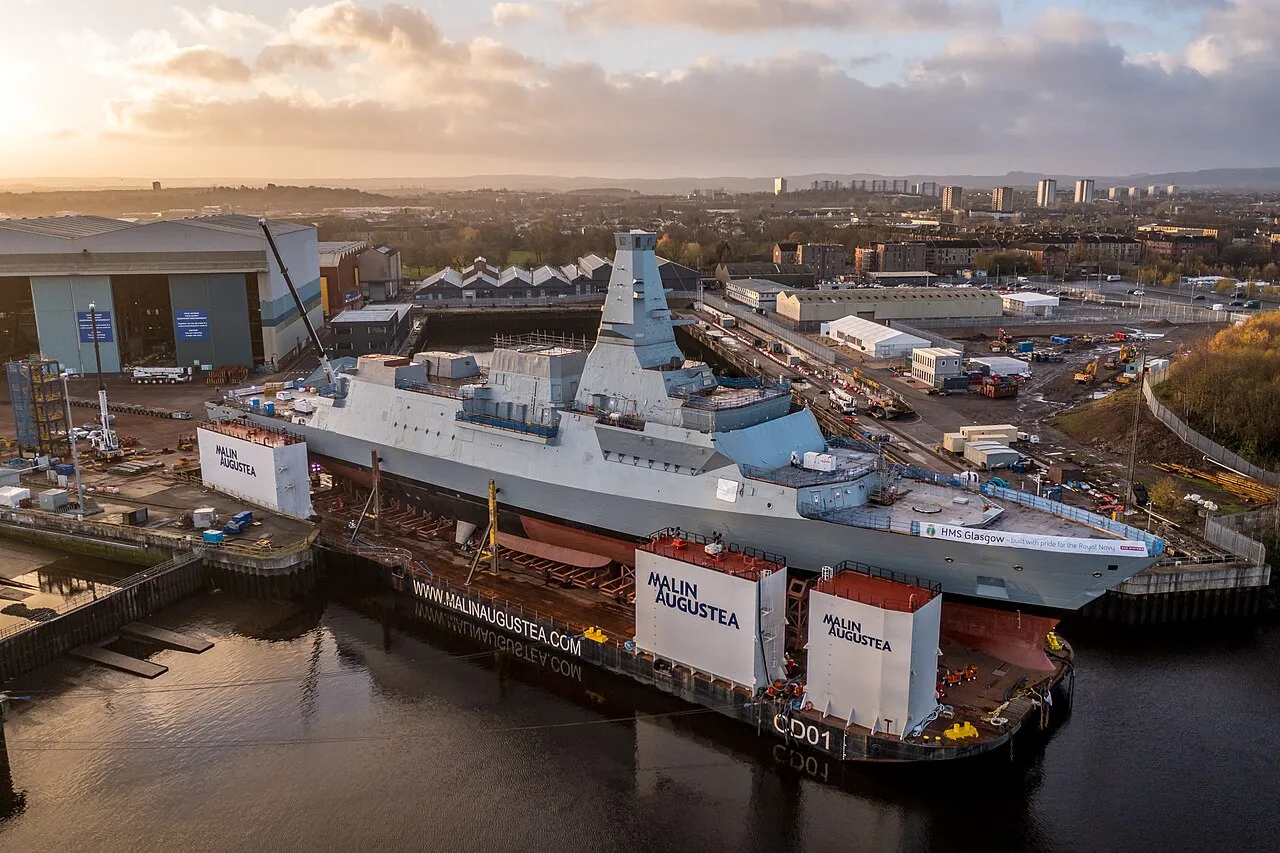
All five are being built and integrated at Rosyth. HMS Venturer, the lead ship, had steel cut in September 2021 and floated out of the assembly hall in mid-2025. HMS Active had steel cut in January 2023. She rolled out of the build hall on the same day that steel was cut on HMS Bulldog, the fourth ship. DE&S dated that announcement 25 February 2026. The same release reported that the keel of HMS Formidable had been laid at the end of last year4. Active then entered the water for the first time when a barge was submerged beneath her, and moved to further outfit work before test and commissioning7. HMS Campbeltown is the fifth name2 in the class.
The program will support around 2,500 jobs in total2, including 1,250 across the wider UK supply chain.
Service history
The Type 31 had no service history as of 2026, when the in-service dates for the class had moved considerably to the right. Earlier statements gave 2023. In January 2020 the Permanent Secretary for Defence told the Public Accounts Committee the in-service date would be in 2027. The naming announcement said by 20281, and DE&S now says the whole class will be in service by the early 2030s. In October 20263 Babcock indicated that the first ship was planned for delivery to the navy in 2028. DE&S lists their intended missions as interception, intelligence gathering, defence engagement and humanitarian support7. In the Royal Navy’s planned fleet the five Type 31s will serve with eight Type 26 frigates, the future Common Combat Vessels and Type 91 uncrewed missile platforms8.
Similar classes
- Type 26 frigate: the Royal Navy’s other new frigate class, dedicated to submarine detection1, where the Type 31 is general-purpose.
- Iver Huitfeldt class: the Royal Danish Navy frigates on which Arrowhead 140 is based5.
- Merah Putih (Red White) class: Indonesia’s Arrowhead 140 derivative, built by PT PAL with Turkish-made combat systems6.
- Wicher class (Miecznik program): Poland’s three-ship version, armed with a 32-cell Mark 41 VLS3 for CAMM missiles.