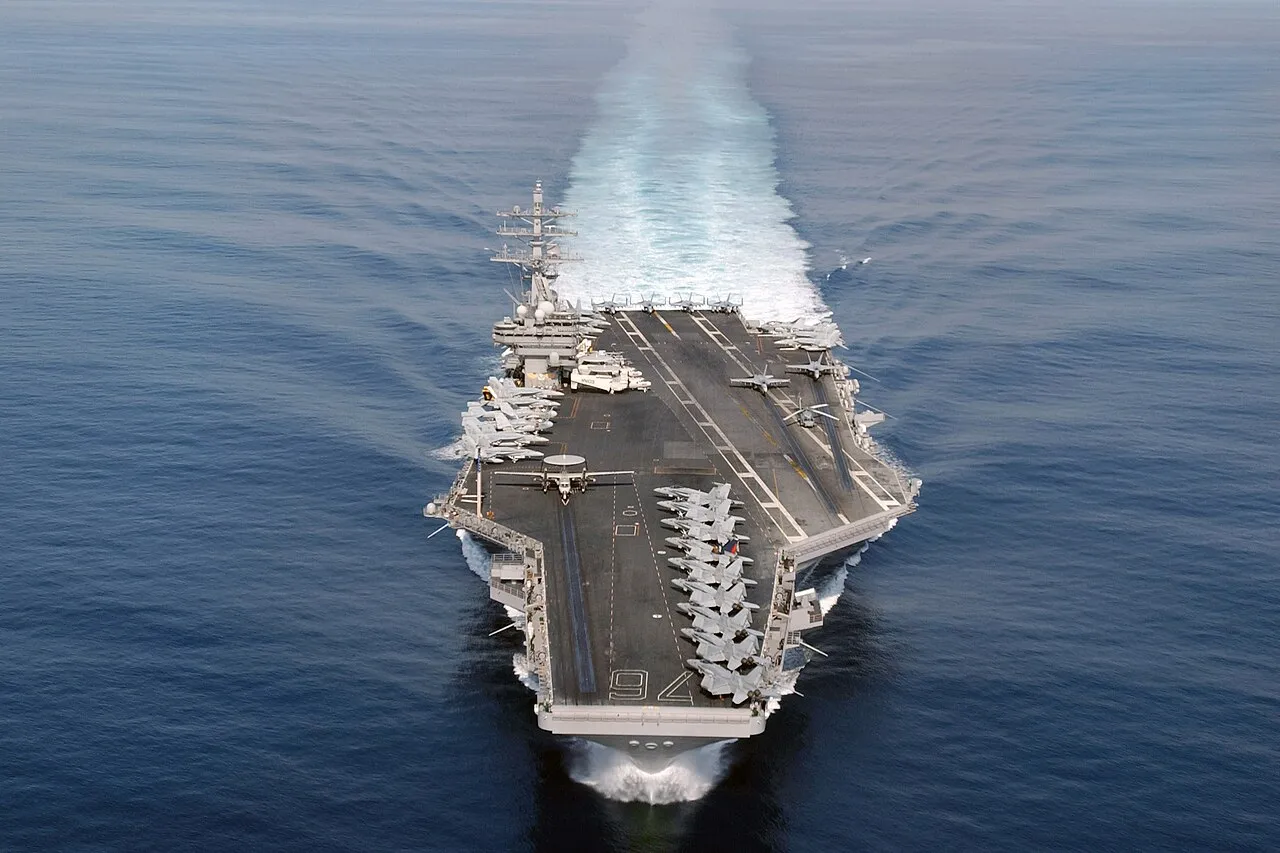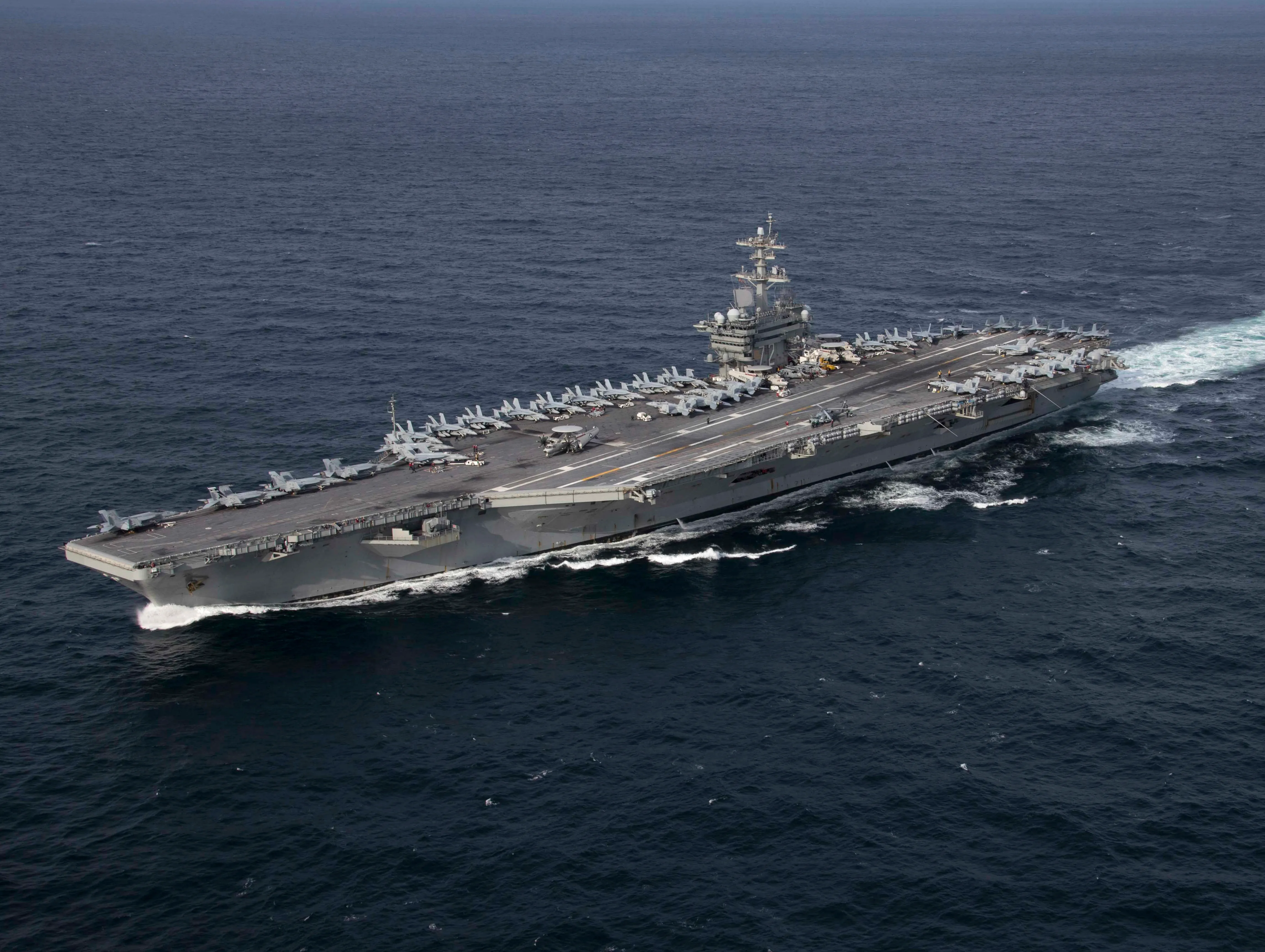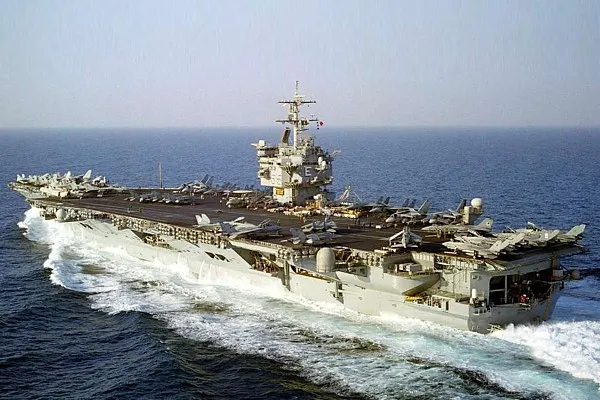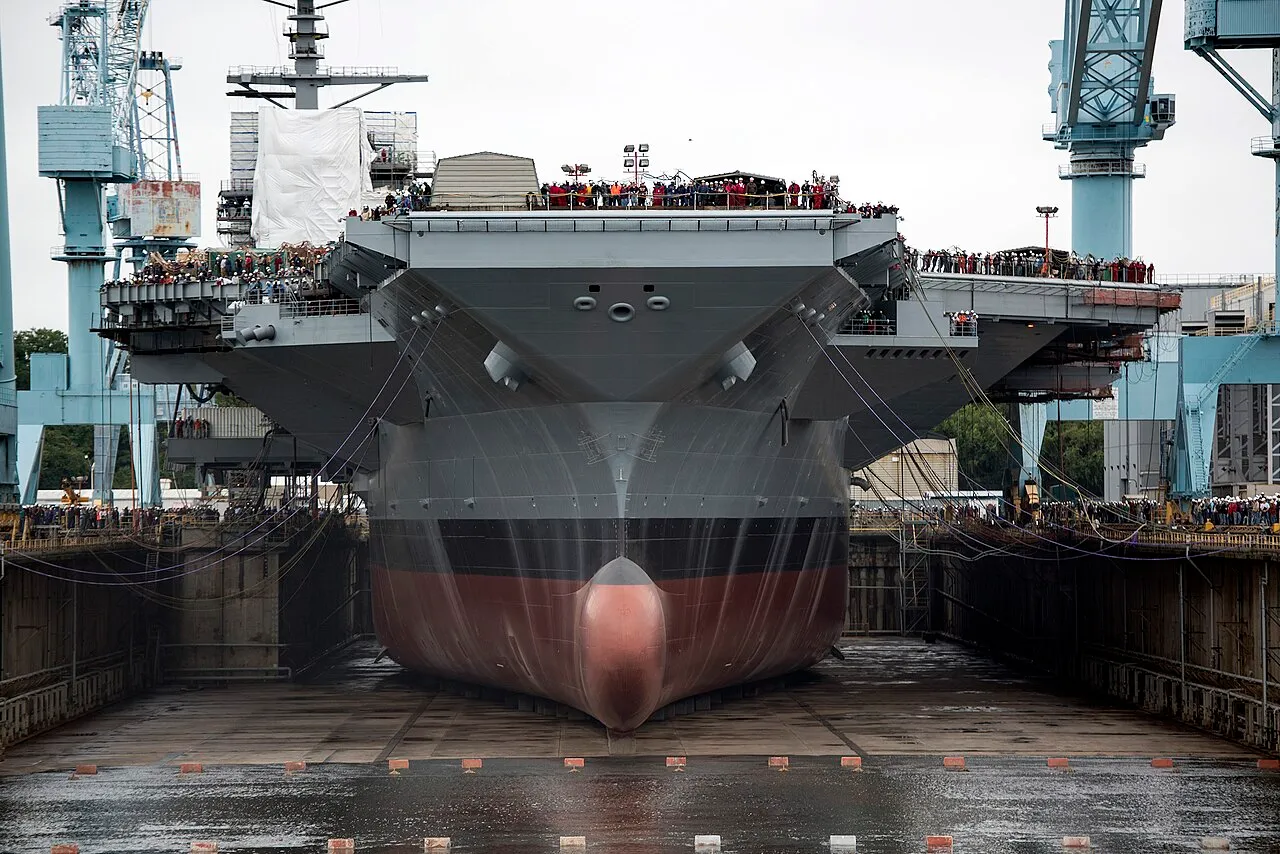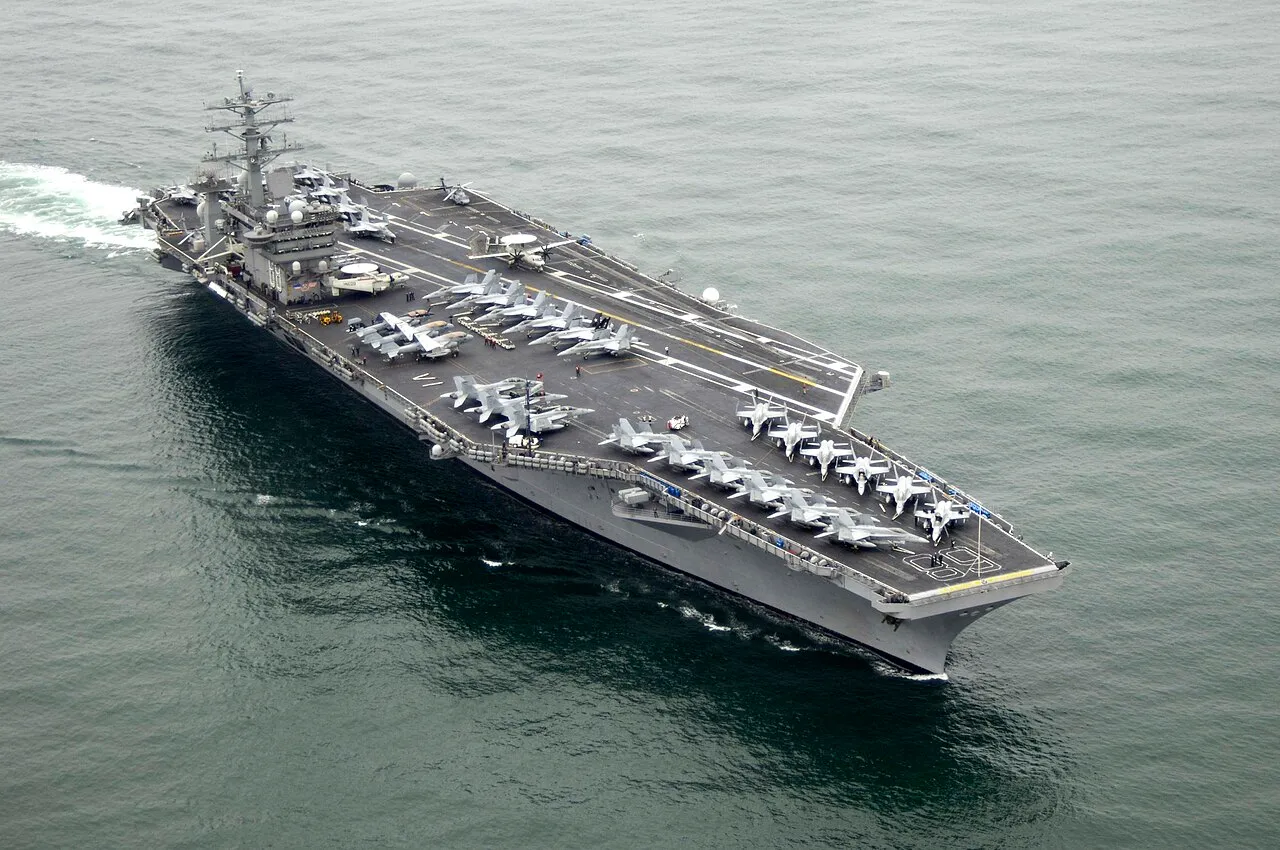
USS Nimitz (CVN-68) is an aircraft carrier of the United States Navy and the first of her class. She was commissioned in 19751, and since the inactivation of USS Enterprise in 2012 she has been the oldest serving aircraft carrier in the world. The 1980 time-travel film The Final Countdown was set and filmed on board2 the ship. In March 2026 the Navy announced she would stay in service until at least March 20273, at least ten months longer than planned.
Design and construction
The ship is named after World War II Pacific fleet commander Chester W. Nimitz, the Navy’s third fleet admiral. Her keel was laid down on 22 June 1968 at Newport News Shipbuilding and Dry Dock Co. in Virginia. She was christened on 13 May 1972 by Catherine Nimitz Lay, the admiral’s daughter, and President Gerald R. Ford commissioned her three years later. She was built as CVAN-68, an attack carrier, and was redesignated CVN-68 on 30 June 19752 as a multi-mission carrier.
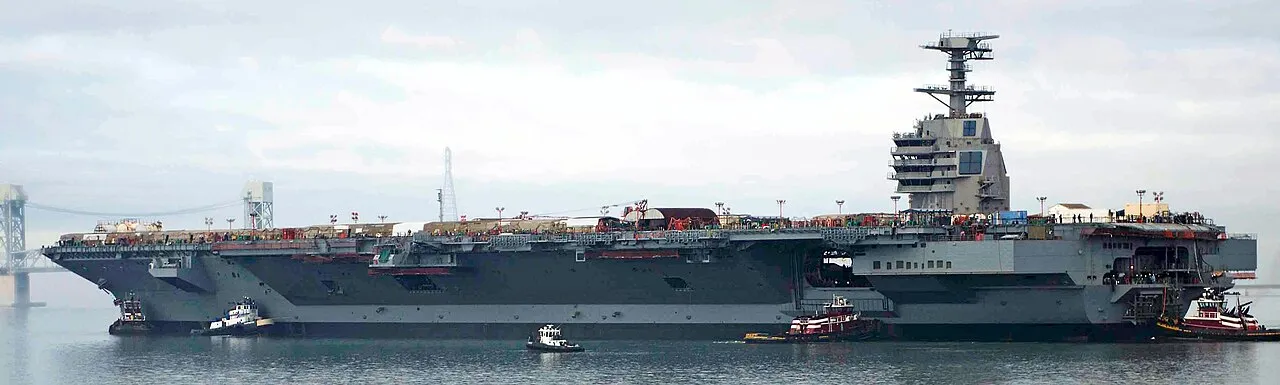
All ten Nimitz-class carriers1 were built by Newport News Shipbuilding in Virginia. The yard’s owner, HII, calls its Gerald R. Ford class the first new US carrier design since USS Nimitz4.
Specifications
Naval Technology gives the class a displacement of 102,000t and a flight deck length of 332.9 m, with over 6,000 personnel on board counting crew and aircrew. The flight deck measures 333 m by 77 m and has four lifts, four steam-driven catapults and four arrester wires. The carrier can launch one aircraft every 20 seconds1.
Two General Electric pressurized-water reactors drive four turbines of 260,000 hp on four shafts, with four emergency diesels besides. The ship reaches over 30 knots. Accommodation is listed as 3,184 ship’s personnel, 2,800 aircrew and 70 flag staff, and the air wing includes up to 82 aircraft1, in a typical mix of F/A-18 Hornets, E-2C Hawkeyes, EA-6B Prowlers and Seahawk helicopters.
The class is fitted with the Raytheon RAM against incoming anti-ship missiles and with four 20 mm Phalanx close-in weapon systems. Nimitz herself was among the carriers fitted with the SSDS ship self-defense system1, designed to integrate and coordinate the ship’s weapons and electronic warfare systems against anti-ship cruise missiles.
Her nuclear refueling and complex overhaul ended on 25 June 20012 after three years in the yard. HII lists Nimitz among the first six ships of the class4 it has refueled, work that is done only once during a carrier’s 50-year life.
Service history
Nimitz first deployed to the Mediterranean on 7 July 1976 with Carrier Air Wing 8. During the Iran hostage crisis, Operation Evening Light was launched from her decks to rescue the US Embassy staff in Tehran; the mission was aborted after a helicopter crashed at a refueling point in the Iranian desert. On 26 May 1981 a Marine Corps EA-6B Prowler crashed on her flight deck, killing 14 crewmen and injuring 452.
In the Gulf of Sidra off Libya, on 19 August 1981, two F-14 Tomcats of VF-41 from the carrier were engaged by two Libyan Su-22s, and both Libyan aircraft were shot down. In 1985, after the hijacking of TWA Flight 847, she was sent to the coast of Lebanon and stayed there until August. She then moved to the Pacific: sailing around Cape Horn, she reached her new home port of Bremerton, Washington, on 2 July 19872.
Nimitz deployed to the Persian Gulf in 1991 and again in 1993, the second time in support of Operation Southern Watch. Her aircraft flew over Iraq and Afghanistan from mid-April 2003 in Operations Iraqi Freedom and Enduring Freedom. In November 2004, two of her F/A-18F fighters recorded data and imagery that some pilots interpreted as an object maneuvering at extraordinary speeds; the incident was publicized in December 2017. On 3 November 2014 the first F-35C Lightning II to land on an aircraft carrier recovered aboard Nimitz2.
Her 2017 deployment was against ISIS in Iraq and Syria, and her F/A-18s gave precision air support in the Battle of Tal Afar. In 2025 her air wing struck Islamic State fighters in Somalia3 and took part in exercises in the South China Sea, where two of her aircraft were lost in separate mishaps within an hour. She returned from what was planned as her final deployment on 16 December 20252.
Planned retirement
The Navy had planned to decommission Nimitz in May 2026, but rescheduled it for March 2027, USNI News reported on 14 March 2026. A $96 million contract went to HII Newport News Shipbuilding for advanced planning and long lead materials ahead of her inactivation. The new date matches the delayed delivery of the Ford-class carrier John F. Kennedy (CVN-79)5, and a 2011 law requires the Navy to keep at least 11 operational aircraft carriers.
The ship left Naval Base Kitsap on 10 March 2026 and sailed for the Atlantic around Cape Horn, joining exercises in the US Southern Command area on the way to her new home port of Naval Station Norfolk3. She arrived in Norfolk on 9 July 20262 and under the March 2026 schedule she stays in service until March 20275.
Sister ships and similar ships
Nimitz leads the Nimitz class of ten carriers. The last, USS George HW Bush (CVN-77), was commissioned in January 20091; the others include USS Dwight D. Eisenhower, USS Carl Vinson, USS Abraham Lincoln and USS Ronald Reagan.
- USS Enterprise (CVN-65): the world’s first nuclear-powered aircraft carrier and the only ship of its class4, inactivated by Newport News Shipbuilding in a process that ran from 2013 to 2018.
- USS Gerald R. Ford, lead ship of the Gerald R. Ford class: the successor design, with electromagnetic catapults4 in place of the steam catapults of Nimitz and more than twice the electrical capacity of the preceding class.